Experts discuss EU role in civil society development
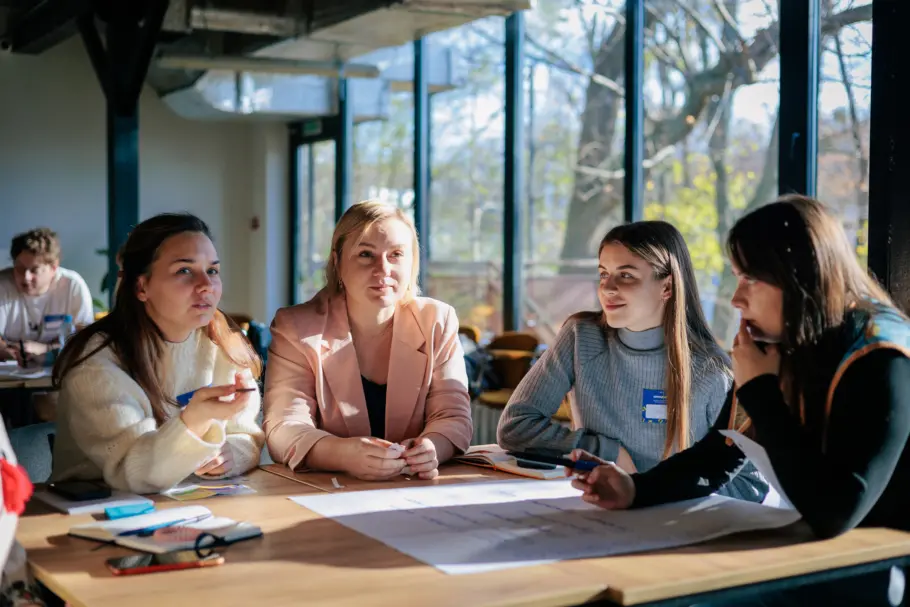
On January 24 Kyiv hosted the discussion “Contribution of the European Union to the development of civil society”, which was taking place within the framework of a joint long term project “Sharing Transformation Experience” implemented by Yatsenyuk Fund “Open Ukraine” as well as the European Programme and the East-East: Partnership Beyond Borders Program of International Renaissance Foundation. Diplomats, public authorities and NGO representatives, media, experts and academics participated in the event.
In his opening remarks, Executive Director of the International Renaissance Foundation Yevhen Bystrytsky stressed the need to develop and strengthen the impact of civil society. The Foundation’s 2011 budget has earmarked nearly $1 million for projects that promote European integration of Ukraine, he said.
Bystrytsky added that the Foundation will focus largely on projects and initiatives centred around civil society monitoring of implementing EU-related commitments by Ukraine’s public authorities and advocating relevant reforms. Promoting cooperation among Ukrainian non-governmental organisations and pan-European civil society platforms, as well as reform-related peer review among the Eastern Partnership countries will remain IRF’s key priorities with respect to European integration, noted the Executive Director.
In turn, EU Ambassador to Ukraine Jose Manuel Pinto Teixeira informed that the Delegation of the European Union supports organisations promoting human rights and democratic values. Currently the EU funds nine projects which cover lifelong learning, prevention of torture, HIV/AIDS care and other areas, His Excellency noted. The diplomat hopes that Ukrainian government will take into account recommendations of the Ukrainian non-governmental organisations (NGOs).
The EU representative noted that the assistance programme for Ukraine is based on the European Neighbourhood Programme priorities. He said that the main beneficiaries of such programs are public authorities, while the EU aims at transforming them and strengthening their capacity.
Civil society played particularly important role in Slovakia when the country decided to move towards a market economy and join the EU, noted Pavol Demes, transatlantic fellow of the German Marshall Fund. According to the expert, a special independent foundation was set up in Slovakia back in the 1990es, which supported civil society projects in the country until it joined the EU.
Yet, as Demes stressed, there is a number of problems associated primarily with government efforts to discredit the fund’s activities, especially when it comes to such politically sensitive issues as policy research and election monitoring. However, Demes said that the abovementioned foundation in Slovakia did manage to counter the pressure.
In his opinion, this successful experience suggests that the country needs an independent civil society just as much as it needs independent media. The expert advised Ukrainian NGOs on successful functioning formula – developing projects which can combine the EU and US aid. He also stressed the role of the Visegrad countries, i.e. the experience of joining efforts by neighbouring countries.
Assya Kavrakova, Director of the European Policies and Civic Participation Program at the Open Society Institute – Sofia (Bulgaria), zoomed in on negative experience, which in her opinion can be of use for Ukraine in order to avoid the same mistakes. Kavrakova said that Bulgaria had a series of unresolved issues, particularly in education, health, and social protection. Implementation of such reforms was highly dependent on political consensus, which disappeared in Bulgaria after the country joined the European Union. This is precisely why, according to the expert, the success of reforms in these areas depends on the activity of civil society. Since such reforms are usually long-term, the political setup led to state’s inability to implement them and marginalisation of certain society groups. Civil society organisations should closely follow these reform areas as they are important to every citizen, stressed Kavrakova.
Development of civil society in Bulgaria, which took place from the top down, represents another controversial practice, says Kavrakova. In her view, this led to a gap between citizens and NGOs, in spite of substantial technical support and financial assistance from the EU, ongoing development of democratic institutions and enlisting of the country’s intellectual elites.
Also, enabling the state administration to distribute funds to NGOs resulted in mushrooming of NGOs and creation of pocket NGOs by political parties – this further reduced sector’s stability and trust of the citizens, notes Kavrakova. Therefore, according to the expert, the activities of civil society must be separated from the political establishment, otherwise even the most fortunate and successful initiatives will not work.
Having compared Slovakia and Bulgaria experience Iryna Solonenko, Director of the European Programme of the International Renaissance Foundation, noted that the EU can enhance or, on the contrary, weaken the position of civil society in a given country, depending on whether the EU is positioning itself as government partner or civil society partner (as opposed to a government that impedes the reforms).
In her opinion, since Ukraine has been moving away from democratic standards recently, the EU should be more explicit in voicing its support of civil society. The expert also believes that the EU should clearly outline the content of what is called European values, the content of the first Copenhagen criteria and thus emphasize that only the countries that meet these criteria can hope for EU membership.
Dmytro Shulga, Senior Manager of the European Programme, pointed out that unlike such countries as Slovakia, Bulgaria, Serbia or Turkey, in Ukraine NGOs get only 0.3% of EU total financial assistance to Ukraine. He is convinced that Ukraine should recommend the European Union to increase this volume.
Still, he said, the question arises as to how these funds can be effectively distributed. In this regard, Shulga thinks, we have to take a closer look at positive experience of Slovakia, and on negative experience of Bulgaria, as well as on how the Civil Society Facility runs in the Western Balkans and on EU-funded Civil Society Dialogue with Turkey.
Igor Bandovic, Programme Manager of European Fund for the Balkans (Serbia), thinks that European integration has become the driving force behind reforms in the Western Balkans. Regional cooperation and reconciliation of conflicts are the key results of this integration, says the expert. Bandovic notes that though the region has established institutional capacities for cooperation of NGOs and governments, he agrees that NGOs have so far had limited influence on government decisions.
Levent Koc, Programme Officer of the German Marshall Fund (Turkey), said that currently Turkey finalised only 13 chapters (while 8 chapters are frozen) out of 35 chapters in the accession negotiations with the EU. According to the expert, despite the fact that Turkey invested much effort in structural changes in 1999-2004, support for the EU has dropped and 10 newly created regional development agencies (out of planned 26) have failed to promote European ideas among the society. Also, notes the expert, in 2006 only 10-15% of EU funding was used, the remainder being returned back.
Bureaucracy and complexity of EU procedures, as well as insufficient preparation and lack of necessary training for Turkish NGOs have remained the key problems, thinks Koc. The application process for financial support is too complicated, and most of small Turkish NGOs are not able to compete, as they do not meet the criteria, mainly financial turnover criteria, expert added. As a result, he said, a whole new industry sprung up, catering for drafting a “well-versed project”; most of the funding goes to foreign consultancies that mainly employ foreigners.
Head of “Centre UA” NGO Oleh Rybachuk informed that this summer the EU will for the first time open its thematic programme “Non-state actors and local authorities” for Ukraine aimed at supporting NGOs and strengthening their institutional capacity in dealing with authorities. Such a step, he said, is appropriate given the lack of systematic dialogue between the Ukrainian authorities and civil society. For now, as the expert noted, the only effective practice of promoting reforms in Ukraine by the EU is the one of “stick-and-carrot” approach.
Analytical materials, prepared by the projects’ experts, are available here.
The event was the first of six that are planned under the project “Sharing Transformation Experience” – a new joint project of Arseniy Yatsenyuk “Open Ukraine” Foundation and the International Renaissance Foundation. The next event within the project has been scheduled for March. The topic of the event is to be announced soon.