

Imagine this: you need to quickly write a social media post, draft an event announcement, summarize a lengthy report, brainstorm ideas for a project, or formulate key points for a presentation. This is a daily routine for most communications professionals at nonprofit organizations.
This is where artificial intelligence comes to the rescue. It doesn’t replace humans, but it can be a very useful helper—an assistant who’s always available, never gets tired, and is ready to assist with texts, ideas, structure, or phrasing. But to use it effectively, you first need to understand what this AI of yours actually is.
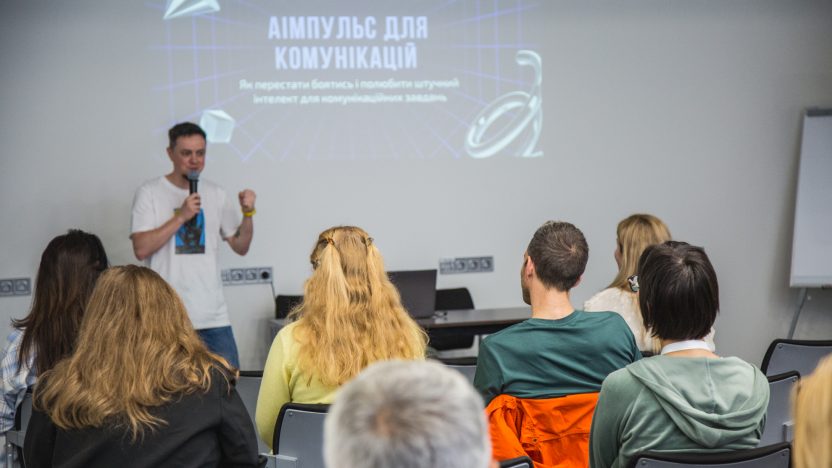
In this text, you’ll find key points on how to formulate high-quality prompts for AI, drawn from the training session “AI Impulse for Communications” led by Sashko Kulchytskyi, Head of the Communications Department at the International Renaissance Foundation. Spoiler: AI also helped write this text.


What AI Is and Isn’t Today
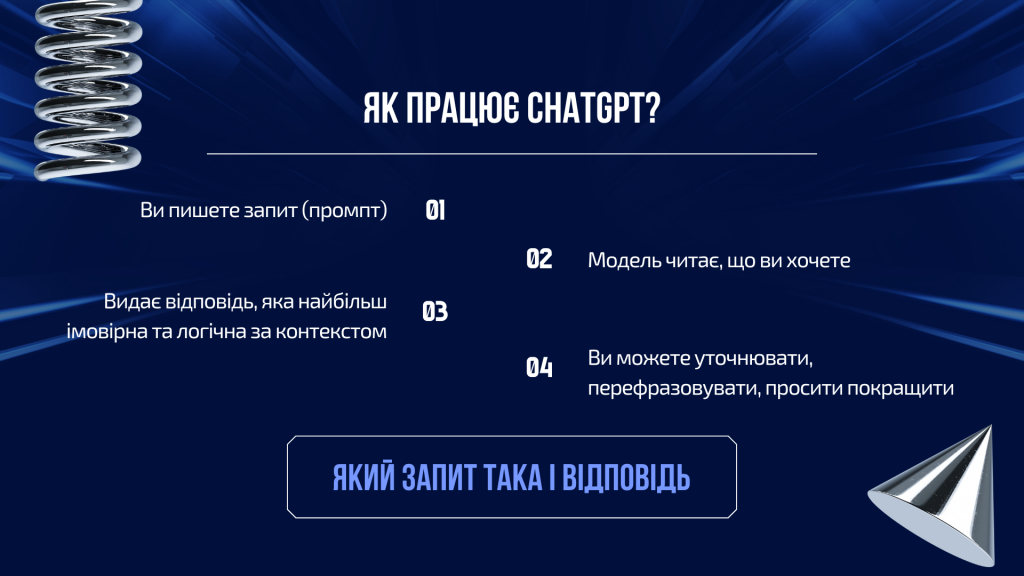
Modern artificial intelligence isn’t a robot from the future or a magician. It’s a computer algorithm. It has learned to generate text by processing billions of books, articles, and websites. But it doesn’t read or comprehend what it produces the way a human does. AI doesn’t know what good and evil are, doesn’t understand jokes, and has no emotions. Its main task is to predict which word best fits next, based on its experience, your query, and the context of previous interactions with you.
In other words, it works like an extremely smart autocomplete feature—like the one on your phone when you’re typing something, and it suggests what word might come next. Only here—instead of a single word, the model can write an entire page, one that’s logical and coherent. Such models are called large language models (LLMs). The most famous example is ChatGPT.
A metaphor by philosopher John Searle, which he wrote about more than half a century ago, can help us understand how AI works. It’s called the “Chinese Room.”
Imagine: a person is sitting in a room and, through a slot in the door, receives a piece of paper with a Chinese character. The person doesn’t know Chinese, but they have detailed instructions: if you receive such symbols, you must give this response. The person follows the instructions and passes the paper back. To someone on the other side of the door, it seems as though the person in the room understands Chinese. But in reality, they’re simply selecting the correct answers based on a template.
Artificial intelligence works the same way. It responds logically, sometimes elegantly and profoundly. But it doesn’t understand the meaning. It doesn’t think. It simply guesses the most likely continuation of the text based on what it has seen before. And, even worse, it tries to do so in a way that you’ll like the answer and won’t run off to competitors offering the same services. This is where the frequent “fantasy” responses from AI come from, when it might invent information or distort it.
An unedited AI output will always be inferior to a professional’s work. In other words, AI isn’t going to take your job anytime soon. But does that mean AI is incapable of anything? Of course not. Let’s talk about how to get the most out of working with AI.
How to Talk to AI to Get Results
We already know that AI doesn’t have its own thoughts, so it certainly can’t read your mind. The golden rule for communicating with AI is simple: the more clearly you formulate your request, the better the result you’ll get. The reverse is also true: if your request is vague, unclear, or confusing, the response will be just as vague.
Imagine you’re assigning a task to a new intern. If you simply tell them, “Write me something nice about the event,” they’ll be at a loss. But if you explain, “You need to write a 100-word Facebook post about the youth event, in a friendly tone, with three main points,” the result will be much better. The same goes for AI.
You need to give it:
A clear task describing exactly what needs to be done: write a post, summaries, ideas, structure, comparisons, etc.
Context: what it’s about, the situation, what’s already known.
Expectations: style, length, tone, structure.
Role. You can even specify who the AI should “be”: “Imagine you’re a communications specialist at a nonprofit” or “Imagine you’re a news editor.”
And, of course, don’t expect the result to meet your expectations right away, so refine them gradually. Feel free to write: “Shorten it,” “Make it more emotional,” “Change the style to formal.” AI works better when you communicate with itтапно.
The RISEN Query Construction Method
The formula for crafting AI prompts that I would recommend first and foremost is called RISEN. It’s an acronym for five simple steps. It helps you create a good prompt so that the AI gives you exactly the answer you need.
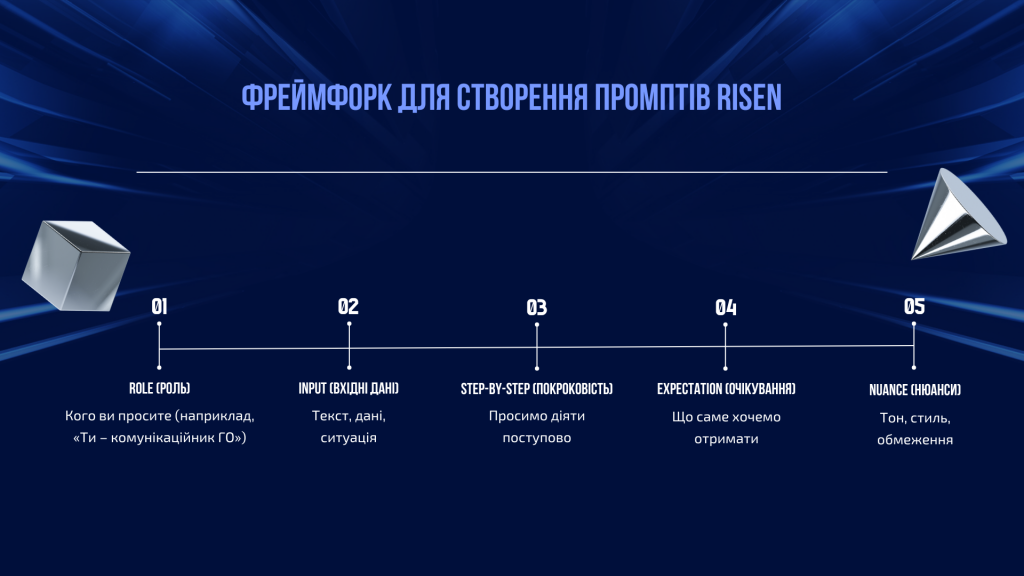
Here’s what the acronym stands for:
R — Role
Tell the AI what role it should play in this task. You can specify not only the profession but also the workplace, years of experience, and so on. For example, “You are an analyst working on the communications team of a nonprofit organization.”
I — Input
Provide material or an explanation of what the AI should work with: text, a situation, a topic. If you don’t provide anything, it will have to guess, and that’s not what we want. For example, “We’ve just completed a major project; the report is in PDF format (detailed, over 50 pages).”
S — Step-by-step
Ask it to perform the task not all at once, but in stages. This way, you’ll get a more accurate and meaningful response. For example, “Work in stages. First, write a brief summary in 3–4 sentences to check your understanding, and then formulate 7 main points (1–2 sentences each).”
E — Expectation
Clearly state what kind of response you expect: length, format, style. This will help the AI orient itself. For example, “Your task: analyze the document and formulate 7 key points that can be used in informational materials: presentations, publications, posts. The points should convey the main ideas, be concise but informative.”
N — Nuance
Add details: who the audience is, what tone is needed, and what’s important to consider. These are the finishing touches that determine the result. For example, “Style—neutral, without excessive emotion, understandable to a broad audience. Don’t use abbreviations without explanations.”
Of course, it’s not necessary to formulate the request in such detail. For most tasks, a shorter request will suffice, such as “You are a communications specialist for a nonprofit. Analyze this PDF report and formulate 7 main points. First, a summary (up to 3 sentences), then the points (1–2 sentences each). The style should be neutral, clear, and free of complex terminology. We’ll use this for a presentation and social media.”
Once you receive the results, you can refine the prompt until you get a response you can work with.
A Chain of Thoughts and Metapromppts
Sometimes the tasks aren’t straightforward: it’s not just a matter of writing a post or a summary, but of conducting a deeper analysis, comparing ideas, drawing conclusions, or identifying connections within a complex document. In such cases, a simple short prompt isn’t enough. This is where two techniques come in handy: the Chain-of-thought method and metaprompts.
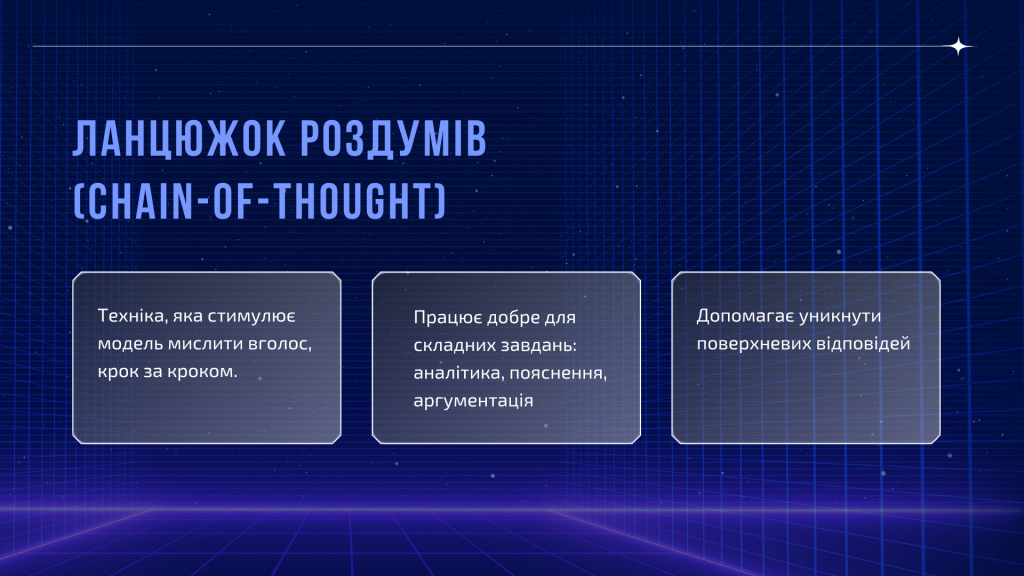
The first technique helps the student avoid rushing to an answer and instead organize their thoughts systematically. You ask them to think step by step. They articulate the logic behind their reasoning and only then formulate their answer. This is especially helpful when the task is complex or multi-layered.
For example, “First, think out loud: into what parts can the text be divided? What seems to be the main point? Which themes are repeated? Then formulate 5 key points, each with a brief explanation.” This helps avoid superficial or random answers.
A detailed prompt would look like this:
I want you to analyze this PDF document and formulate 7 key points based on it. But don’t do it right away. First, think aloud. Explain how you plan to approach the analysis: what you’ll pay attention to, how you’ll determine what’s important.
Then, as you read, comment on your understanding: which topics recur, what seems central, and what data supports the key conclusions.
Only then should you formulate the 7 points. For each point, include a brief explanation of why it is important.
Context: The theses will be used to create content for the website and social media of a nonprofit organization.
Style: simple, informative.
The metaprompter technique simplifies the task even further. When you find it difficult to formulate a prompt on your own, ask the AI itself to help you write the right prompt. This is a metapromp—a prompt that asks the model to create another, better prompt.
For example, “Help me write a prompt that I can use to analyze a 50-page PDF document. I want to get 7 key points for posting on social media. The style should be simple and neutral.” You can ask for several prompt options at once, then select one that you can edit and use.
A longer version of such a request would look like this:
Help me formulate an effective prompt that I can use to analyze a 50-page PDF document. I want GPT to read it, understand the main ideas, and formulate 7 key points for further use in a nonprofit organization’s communications materials. The points should be brief but substantive, without unnecessary emotional overtones, and written in a clear style. Suggest one or more prompt options that I can use with the PDF document to achieve a high-quality result.
***
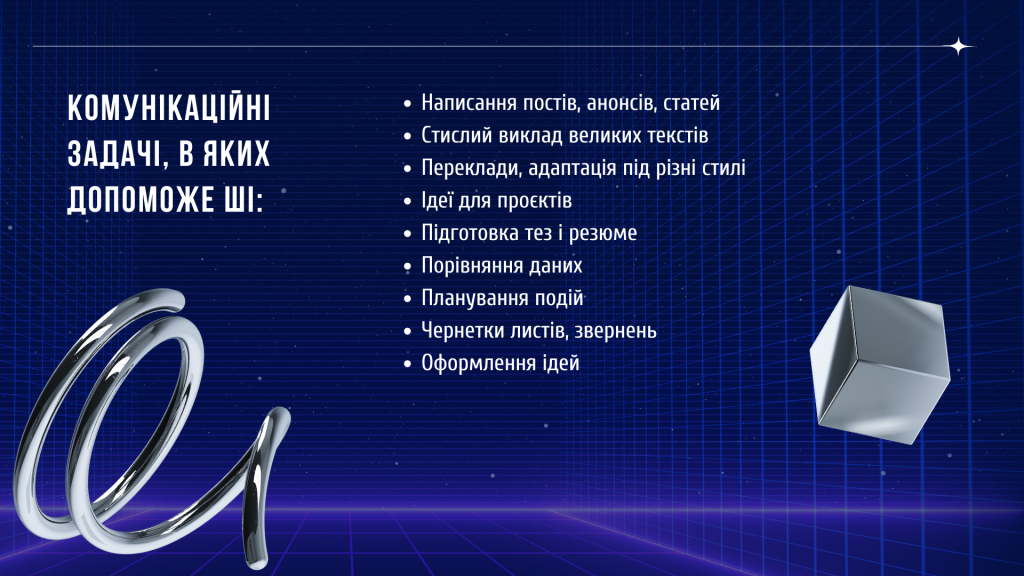
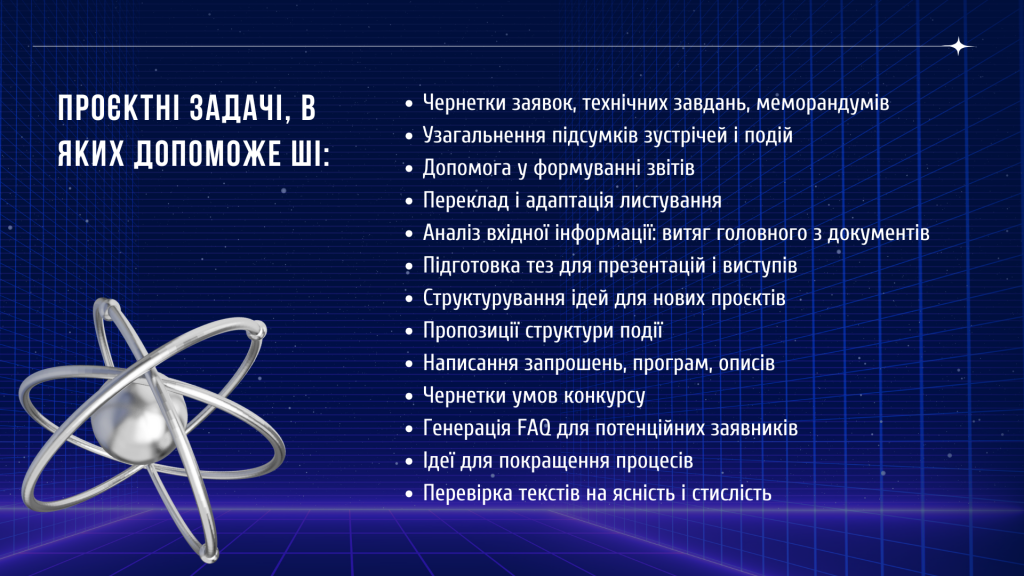
AI won’t replace you. But it’s very good at helping with routine tasks. It’s like an intern who never gets tired, never takes offense, and is always ready to draft something. And the better you explain the task to it, the better the draft you’ll get.
AI can:
write a draft of a post, announcement, letter, or statement;
generate ideas for a campaign or event;
condense a long text into a few key points;
translate and adapt text for different styles or audiences;
organize ideas into a structure: for example, for a project proposal or presentation;
prepare meeting summaries, event plans, or data comparisons;
assist with technical specifications, memorandums, invitations, FAQs, or even contest rules.
But it’s important to remember: what AI generates is a draft, not a final version. Its texts need to be proofread, adapted, fact-checked, and given a human touch. Because only you know the context, the goals, and the people for whom it is being written.
So treat AI not as a magical entity that will grant your wishes, but as a tool. Like a Swiss Army knife that can help you do your work faster, simpler, and easier. But you’re still the one doing the cutting.
The document was prepared within the framework of the Impulse Project implemented by the International Renaissance Foundation and the East Europe Foundation with funding from Norway (Norad) and Sweden (Sida). The contents do not necessarily reflect the position of the International Renaissance Foundation, the East Europe Foundation, the Government of Norway, and the Government of Sweden.


