

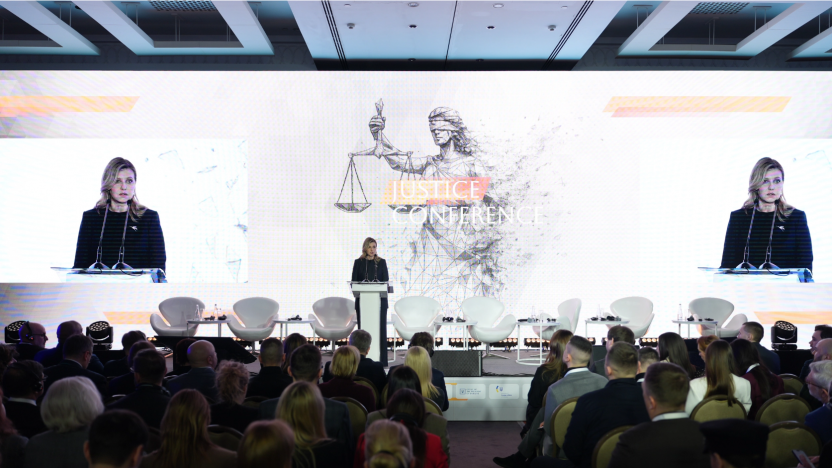
The Justice Conference served as a key platform to coordinate steps on a Special Tribunal, compensation system, and the return of abducted Ukrainian children.
On 23 February 2026, Kyiv hosted the Justice Conference, a flagship international platform dedicated to global dialogue on the rule of law, and restoration of justice in the context of war and post-war transformation in Ukraine.
The conference was organised by the Office of the President of Ukraine, the Ministry of Foreign Affairs of Ukraine, the NGO Tribunal (Ukraine) and the NGO Justice and Accountability for Ukraine (United Kingdom).
Justice Conference became a point of coordination for political and legal decisions regarding the creation of a Special Tribunal, the formation of a compensation architecture, and practical steps for the return of illegally abducted Ukrainian children.
The event was attended by representatives of the Ukrainian government, international institutions, the diplomatic corps, human rights organisations, the legal community, business and civil society.
Addressing the participants of the Justice Conference, the Head of the Office of the President of Ukraine, Kyrylo Budanov, noted the key role of justice, global unity and the inevitable responsibility of the aggressor state in ending the war.
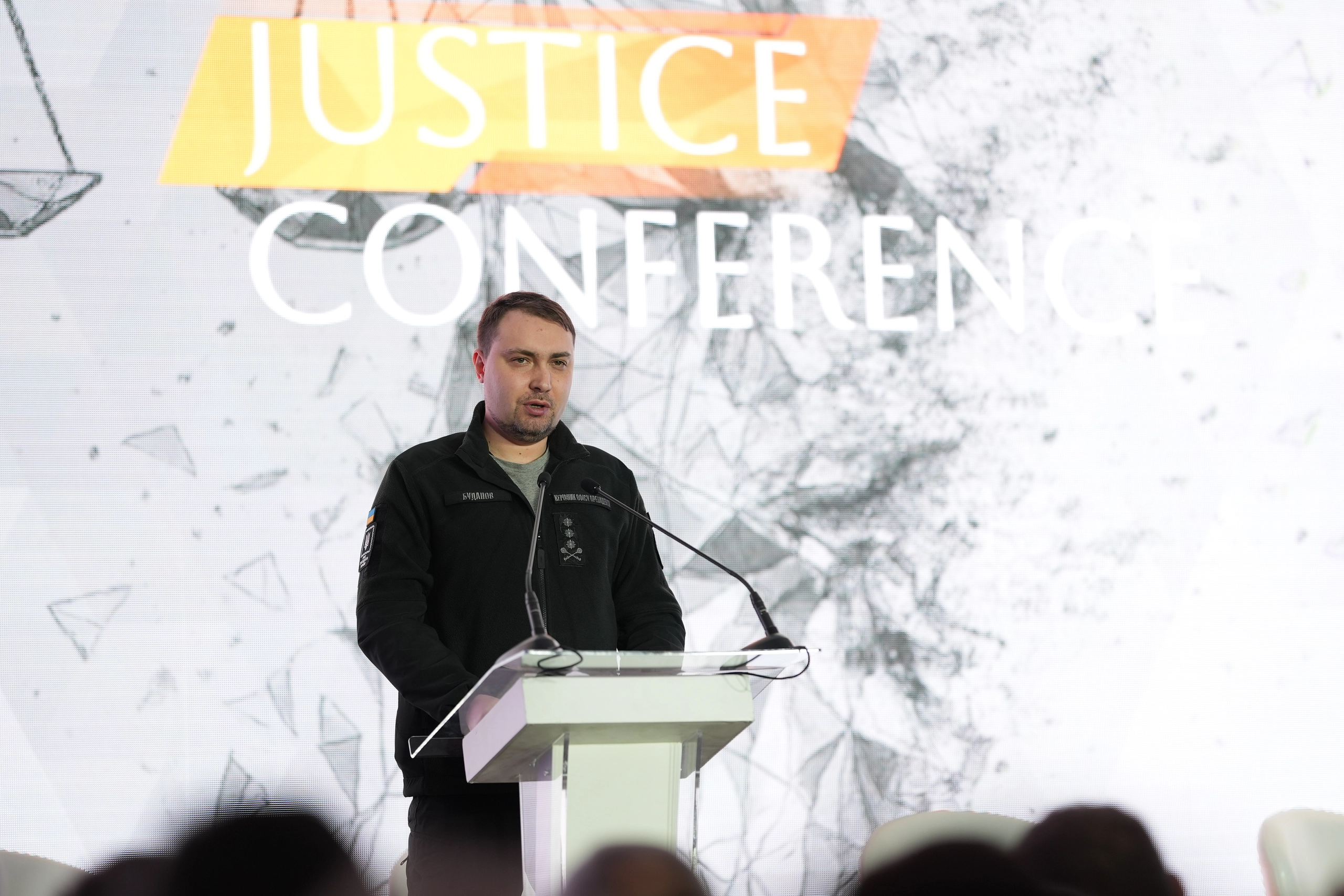
The Head of the Office of the President of Ukraine, Kyrylo Budanov, addressed the Kyiv Justice Conference on Monday, Feb. 23.
“We fully understand that such wars do not end on their own. They either end with a just solution or inevitably return in an even more massive and dangerous form. Therefore, our attention is focused on peace negotiations that should not only end the war but also prevent Russia’s bloody aggression from happening again. At the same time, we must remember that peace without accountability is merely a pause in hostilities, not a solution to the problem. Peace without consequences for the aggressor is an invitation for repetition in different parts of the world,” noted Kyrylo Budanov.
According to him, Moscow is testing the resilience of the global order and the viability of international institutions. The Kremlin launched and continues its war against Ukraine in blatant disregard of international law, because an independent Ukraine is a death sentence for Russian imperialism and Great Russian chauvinism.
“Without Ukraine, the restoration of the empire is impossible, we know this very well. Putin sees Ukraine only as a way to restore the spheres of influence of the Russian Empire and the former USSR. In Europe, Asia, Africa, and even on the American continent and in the Arctic. But we have stood in the way of these plans, both in Europe and, incidentally, in Africa… However, we are now approaching the moment when all parties will have to make final decisions: to continue this war or to move towards peace. I hope that justice will prevail after all,” said Kyrylo Budanov.
When and how will those who started the war be brought to justice?
One of the key topics of the Justice Conference was the creation of a Special Tribunal for the crime of aggression against Ukraine.
The participants of the first panel emphasised that Russia’s war against Ukraine is a challenge to the entire system of international law. Without a legal mechanism for punishing the highest military and political leadership of the aggressor state, it is impossible to talk about justice and trust in international institutions.
“First, when Ukraine starts something, it is accustomed to seeing it through to completion. Therefore, when we initiated the process of establishing a Special Tribunal, we were fully aware of the seriousness of this issue, and we will continue to follow this approach.Second, the crime of aggression is the supreme crime. As a civilized international community, we cannot allow it to go unpunished. Because if there is no accountability, aggression will never stop – neither in Ukraine nor against other countries of the world. Moreover, this would encourage potential aggressors who are currently waiting, and prompt them to initiate aggression,” noted Ihor Zhovkva, Deputy Head of the Office of the President of Ukraine.
Compensation for damages. When will the Russians pay?
A separate section of the conference was devoted to the practical launch of the compensation mechanism. Deputy Head of the Office of the President of Ukraine Iryna Mudra called on international partners to speed up the adoption of decisions necessary to launch a full-fledged compensation mechanism.
According to her, the first element of the mechanism – the Register of Damages – is already accepting applications from victims. Currently, more than 100,000 cases have been submitted, and approximately one-third of the categories of applications have been opened. At the same time, some of the damage, in particular business losses, state losses and environmental damage, is not yet covered by the procedure.
The second element of the mechanism, the Compensation Commission, also requires more active action from partners.
“Thirty-six states have signed the Convention establishing the commission. Twenty-five ratifications are required for it to enter into force. Ukraine has already prepared the relevant draft law for submission to the Verkhovna Rada. We call on states to complete ratification by mid-year so that the commission can begin its work as soon as possible,” emphasized Iryna Mudra.
The key element of the mechanism – the Compensation Fund – will determine whether the entire mechanism proves effective. Iryna Mudra stressed that Russia’s legal obligation to compensate for the damage caused has already been recognized by the international community, and that the Fund’s financial architecture must be developed in parallel with the establishment of the Commission.
“If we fail to ensure real financial accountability of the aggressor state, the rules-based order will lose its meaning. The compensation mechanism, together with the Special Tribunal, is a chance to preserve the system of international law,” stated Iryna Mudra.
A stolen future. How can Ukrainian children be brought back?
One of the most emotionally charged segments of the Justice Conference was the discussion on the return of Ukrainian children who have been unlawfully deported and abducted by Russia.
Participants of the third panel emphasized that the abduction of tens of thousands of Ukrainian children, and possibly even more, is a fundamental element of Russia’s military strategy. At present, this is arguably the largest case of child abduction in modern history.
“Russians removed our children from the occupied territories entire orphanages at a time. They took children whose parents had previously been killed in Mariupol and other Ukrainian cities that they themselves destroyed. The invaders systematically seize children during attempts to leave through checkpoints. In the temporarily occupied territories, children are forcibly taken from their families, including as punishment for parents’ refusal to cooperate with the occupation administration. And very often this is full-fledged captivity, with detention and intimidation. We know this from the testimonies of nearly two thousand children who have been returned,” said Olena Zelenska, First Lady of Ukraine.
Olena Zelenska provided further examples of other crimes committed by Russia against Ukrainian children. Ukrainian teenagers are sent to militarized camps for so-called “re-education,” and boys who reach adulthood are mobilized into the Armed Forces of the Russian Federation in violation of international law. Ukraine already has confirmed cases in which these young men have taken part in the war against their own country, and many of them have already been killed.
According to the First Lady, younger children have their personal data altered, their names and surnames changed, and even changes in transliteration significantly complicate efforts to locate them in official registries. Children are isolated from the Ukrainian information space and from their families, their means of communication are confiscated, and they are punished for using the Ukrainian language. There is also a systematic separation of siblings, who are transferred to Russian foster families, often including families of Russian state officials.
“Ukraine, unfortunately, does not currently have sufficient capacity on its own to return all deported children without systematic international assistance. But in our country, we strive to restore their lost opportunities and dignity. They must know that they were searched for, that they were awaited, that they are needed and important. That they are valued. Yet there is something without which healing is impossible, and that is justice. And it is precisely the restoration of justice that those who have suffered these crimes seek the most,” Olena Zelenska noted.
Justice and fairness after the war
During the fourth panel, participants discussed what the system of justice should look like after the end of the war. It was emphasized that justice must not be a declaration, but a real and effective instrument.
“Ukraine is integrating justice for victims, accountability of the aggressor, and European integration into a single model of post-war justice. This means the systematic documentation of the damage caused, the creation of real compensation mechanisms, and the development of transitional justice, as well as the professional and impartial adjudication of war crimes in accordance with international standards,” stated Iryna Mudra, Deputy Head of the Office of the President of Ukraine.
An international platform shaping the future of the legal system
The Justice Conference confirmed that the global coalition in support of Ukraine is moving to the practical implementation of key mechanisms – from the compensation architecture to the establishment of a Special Tribunal.
Participants of the event emphasized that justice for Ukraine is a prerequisite for the security of Europe and the world, and that holding Russia accountable must become the foundation of a new rules-based global order.
The Justice Conference partners include representatives of businesses and charitable organisations: Oschadbank, Hepatica Foundation, the International Renaissance Foundation, Culver Aerospace, and the European Payment System.
Source: Kyiv Post
