

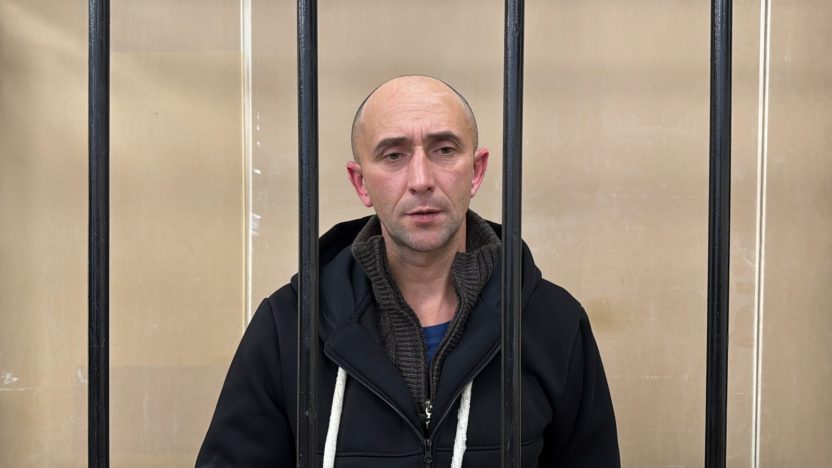
Russian repressive authorities worked hard in December to end the year with medals and bonuses. There were no more “political” cases against Ukrainians, but they became more absurd. It seems that in order to maintain the pace of their production, Russian security forces and completely dependent courts have completely stopped paying attention to logic. More and more of the sentences handed down against Ukrainians are repeat ones. In at least one case, Russian propaganda reported the same sentence three times in six months. At the top of the main photo is Ihor Skubak, a member of the Azov Regiment convicted by the Russians.
Hit parade
What seemed like an isolated bloody excess by an individual in November developed into a trend in December. From the end of November to the end of December 2025, Russia reported six cases of Russian security forces killing “terrorists” who allegedly resisted arrest.
At least one case involved a person whom even the Ukrainian special services would not have spared. Stanislav Orlov from Moscow, the leader of the paramilitary group “Espanyol,” which fought against Ukraine, was killed at a dacha in occupied Crimea.
It was reported that Orlov participated in the occupation of Crimea and hostilities in eastern Ukraine in 2014. His group, formed in 2022, was disbanded in October. Orlov himself and other members of the group were allegedly suspected of organizing a criminal group and arms trafficking. This is not the first case in recent months where the Russian repressive machine has turned against its own people.
In three of the remaining five cases of “killings while resisting arrest” — in Crimea and the Russian regions of Tyumen and Kaluga — the victims were citizens or natives of Ukraine. This is quite logical from the point of view of Russian propaganda, which brands hundreds of Ukrainian prisoners of war as terrorists and, as can be seen, systematically persecutes civilians of Ukrainian origin.
The FSB did not name any of the men allegedly caught while preparing terrorist attacks in its reports on their killings. Therefore, it is possible that all these cases, except for the murder of Orlov, which was not reported by official Russian authorities, are just another series of propaganda fabrications.
Russian authorities spread numerous propaganda fabrications about “Ukrainian atrocities” in December. These included “exposés” of alleged killings of local civilians by Ukrainian servicemen in Pokrovsk, as well as torture and killings of Russian prisoners of war.
This appeared to be a reaction to numerous testimonies about Russian torture given by Ukrainians who had recently returned home after prisoner exchanges. The Russian Investigative Committee even reported the in absentia conviction of the head of one of the Ukrainian colonies, where violence was allegedly used against Russian prisoners.
It is hardly a coincidence that this happened against the backdrop of widespread news in Russia about the persecution of its own servicemen who had been returned from Ukrainian captivity. The Wall Street Journal recently published an article stating that Russian families are trying to lobby for their relatives held captive in Ukraine not to be included in the exchange lists. They argue that the conditions of their detention in Ukrainian prisons are better than life in Russia, where they are treated as traitors.
On top of everything else, Russia’s quasi-legal “Internal Affairs Department of the Military-Civilian Administration of Kharkiv Region” has also started fabricating criminal cases against Ukrainians. Among the most absurd cases are the case against a police officer from Vovchansk for “participation in an illegal armed group” and ‘espionage’ and the case against the owner of an agricultural enterprise in the Lozivsky district for “assisting the enemy in activities knowingly directed against the security of the Russian Federation.”
In order to ensure that the annual plan for initiated and “solved” cases was met and exceeded, in early December the FSB announced the arrest of Ukrainian citizen Chingiz Savchenko for participating in an attack on a company of Russian paratroopers in Chechnya in 2000 as part of the “Basaev and Khattab gang.” Savchenko, who is described as a serviceman of the Armed Forces of Ukraine, was also “detained for counteracting a special military operation” and allegedly fell into the hands of Russian security forces in the Smolensk region. A Russian video recording of the “testimony” of the captive Chingiz Savchenko, made almost two years ago, can be found online, in which he says that he served in the Armed Forces of Ukraine as a clerk since April 2021. Savchenko claimed that in September he left his unit, which was then fighting in Pisky, without permission and tried to return to Mariupol. The published recording is incomplete; the story actually ends with an agreement in 2023 with a “guide” who was supposed to take the man across the border for a fee.
There are several administrative cases against Savchenko in court records. According to these records, in the last week of June 2023, he was caught three times in different areas of the Ukrainian-Moldovan border in the Odessa region while attempting to cross illegally. Presumably, his fourth attempt was successful: the Smolensk region borders Belarus, through which the only land route since 2023 passes, allowing Ukrainian citizens to travel to the occupied part of Ukraine.
Lyudmila Stryukova was “tried” three times
In Russia, Chingiz Savchenko suffered the fate of hundreds of Ukrainian civilians who were abducted from their hometowns and villages in the Kyiv, Sumy, Kharkiv, and Chernihiv regions in 2022. They are being held in Russian prisons for “counteracting a special military operation” without investigation or trial, because there is no such article in Russian law.
However, it is surprising that Savchenko has not yet been charged with anything else, given his even fictitious experience of service in the Armed Forces of Ukraine. Since the beginning of the full-scale war in the occupied territories, the Russians have been fanatically searching for people who participated in hostilities in eastern Ukraine since 2014 or in the “blockade of Crimea” since 2015. In the first half of December alone, two civilian men were detained and three or four were convicted for allegedly belonging to “nationalist battalions” in the past.

One of these four, a man from the Novoaydar district of Luhansk region, was sentenced to 17 years in prison for serving in a “nationalist formation.” This is likely Bogdan Gav’yada, whose conviction was briefly reported by the Russian Mediazona. In one of the Russian databases of killed and captured Ukrainian military personnel, the date of the man’s disappearance is listed as February 24, 2022. It is unclear in what capacity and under what circumstances he disappeared.
The names of the detained former military personnel are unknown. One of them is said to be a 52-year-old resident of Energodar who allegedly fought in the Luhansk region in 2017-2020 as part of the Donbas battalion. The second “immediately after the start of the special military operation, together with his comrades-in-arms, fell under the command of the neo-Nazis of the Azov regiment,” and after the occupation of Mariupol, “hid in the city for three years.”
The names of the convicted former military personnel were also not disclosed. They included a 48-year-old man from the Henichesk district in the Kherson region, who allegedly participated in the “blockade of Crimea,” a 34-year-old man from the Luhansk region, who allegedly served in the “terrorist” Aidar (for only six months), and another man from Luhansk region, from Rubizhne, about whom no personal information was provided. The man from Kherson was sentenced to eight years in prison, and the two men from Luhansk, both of whom were allegedly involved in logistics, were sentenced to 5.5 and six years, respectively.
In the first half of December, four cases of politically motivated detentions in the occupied territories were reported. At least one of them clearly took place earlier. In a video of the detention of a 63-year-old “SBU pensioner” from Kerch in Crimea, the man is led past lawns with green grass and flower beds. The man was detained for allegedly “calling for terrorism” in comments on Telegram. Based on data from the Russian state register of extremists and terrorists, Memorial suggested that this man was Sergei Obushny, a native of Cherkasy.
The fourth detainee is an employee of the “Ministry of Emergency Situations” in occupied Luhansk region, who allegedly passed information about the locations of Russian military units to Ukrainian intelligence. There were also reports of a ten-year prison sentence for an employee of the same “ministry” in the same region on similar charges. The woman’s name was not disclosed.
In the first half of December, the Russians convicted four or five more women from the occupied part of Ukraine on “political” charges. In addition to Yulia Mosyazh, whom the IHRC mentioned in its previous monitoring report, these include 65-year-old Irina Sukhovoy from Melitopol and 61-year-old Marina Bilousova from Primorsk in the Zaporizhzhia region, as well as another unnamed 23-year-old resident of Melitopol.

The girl was fined for comments on Telegram “aimed at humiliating the dignity of a group of people” “on national grounds.” Bilousova and Sukhova were both sentenced to 12.5 years in prison for transferring funds to the Ukrainian Armed Forces. The Crimean occupation prosecutor’s office also reported the conviction of a 55-year-old resident of Melitopol on similar charges. All available details of the case, however, coincide with the details of Irina Sukhova’s case: presumably, the “prosecutor’s office” made a typo in indicating the woman’s age.
The most surprising report, however, concerned the conviction of 32-year-old Lyudmila Stryukova in Donetsk Oblast: as reported by the International Institute for Human Rights, the pro-government Russian media reported on this sentence three times: in July, November, and December of last year. All reports referred to the same court and the same prison term: 13 years. It is unclear why it is necessary to repeat this particular sentence. The Russian organization Memorial noted that Stryukova is the mother of three children.
There are four other known sentences under “political” articles against Ukrainian civilians. The names of three of them are not specified. Among them is a 61-year-old resident of Kakhovka in the Kherson region, who was sentenced to 19 years in prison for allegedly putting “inscriptions and drawings” on monuments and bus stops with calls for violence, presumably against the Russian occupiers.
The other two are a 34-year-old resident of Yakymivka in the Zaporizhzhia region and a man from the Luhansk region who worked for the same unnamed mobile operator. Both were tried for “treason” and “espionage.” Usually, the transfer of information to Ukrainian special services is prosecuted under one of these articles, depending on the citizenship of the defendants. Both men, according to the occupation courts, collaborated with Ukrainian special services both before and after obtaining Ukrainian citizenship. The man from Luhansk was identified thanks to a published video featuring him: he is 29-year-old Yegor Kuch.
The man from the Zaporizhzhia region, who was also accused of transferring funds for the needs of the Armed Forces of Ukraine, was sentenced to 15 years in prison, while Kuch, who allegedly passed on the phone numbers of employees of the occupation forces to the SBU, was sentenced to 20 years.
Mediazona also reported on the sentencing in Yekaterinburg, Russia, of 55-year-old Andriy Lazarenko from Mariupol to 18 years in prison for “attempted terrorism” and “treason.” The man allegedly attempted, on behalf of the Armed Forces of Ukraine, to set fire to a military registration office in Mordovia, where he was forcibly transported in 2022 after being detained at a checkpoint at the entrance to Mariupol.

In Mordovia, the man was allegedly detained at the scene of the crime, but in court he claimed that he was taken from the apartment he rented while working as a janitor and forced to sign about 20 blank sheets of paper during interrogations. In court, Lazarenko also demanded that his Ukrainian passport, which had disappeared from the case file, be returned to him.
The Russian publication Pervy Otdel calculated that as of December 10, Russian law enforcement agencies had opened cases for “espionage” and “treason” against at least 1,627 people, 564 of whom, or 35%, were Ukrainian citizens. The publication also noted that in 2025, people were sentenced to life imprisonment under these articles for the first time in Russia. Pervy Otdel recorded four such sentences. All of them were against Ukrainian citizens.
Obsession with Azov
There are at least 18 known sentences against Ukrainian prisoners of war handed down in the first half of December. Among them is one life sentence: Russian courts have been handing down several such sentences per month since September. This time, Igor Skubak was convicted for allegedly killing two Russian prisoners of war for saying “Glory to Russia” — also a clear reference to real Ukrainian history: the killing by Russians of captured Ukrainian Armed Forces soldier Oleksandr Matsievsky in 2023.
Most of the prisoners of war convicted in the first half of December belonged or allegedly belonged to Azov and defended Mariupol. They are Maksym Cherednichenko, Serhiy Spanchek, Oleksandr Pedak, Valeriy Yeremeyev, Danylo Ovcharenko, Oleg Abdyukov, Hennadiy Minakov, and Sevastyan Zaikin.
Cherednichenko and Pedak were “tried” again. Pedak’s prison term was increased from 25 to 32 years. Cherednichenko, who had previously been sentenced to 26 years for allegedly murdering a Mariupol resident, was sentenced to 18 years for “participation in a terrorist community.” The total length of the man’s prison sentence was not disclosed.
Spanchek and Minakov were sentenced to 18 years in prison, Yeremeyev and Zaikin to 22 years, Ovcharenko to 26 years, and Abdikova to 27 years in prison. Ovcharenko and Abdikova received some of the longest sentences for the Azov members, even though they were not charged, like most of the others, with the murder of a random civilian “on the basis of hatred.”
The defenders of Mariupol, Dmytro Stryzhevsky, Dmytro Leontiev, Oleksandr Dolinyak, Mykyta Korobitsyn, and Vitaliy Bochkov, were also sentenced to 23-24 years in prison. The men were “tried” for “artillery shelling of civilian infrastructure in Mariupol” carried out under a “criminal plan of Ukraine’s top political and military leadership.”
Oleksandr Zherebnyi and Artem Chibisov were sentenced to 16 years for allegedly participating in the invasion of the Kursk region, although Zherebnyi was captured near Pokrovsk in the Donetsk region, and Chibisov was captured in the Sumy region. A Czech and Vietnamese citizen, Minh Hoang Tran, was also sentenced to 13 years in prison for “mercenary activity.” He was allegedly captured in August in Donetsk region, but for some reason was “tried” in occupied Luhansk region.
This material was prepared with the support of the International Renaissance Foundation. The material represents the authors’ views and does not necessarily reflect the position of the International Renaissance Foundation.

