

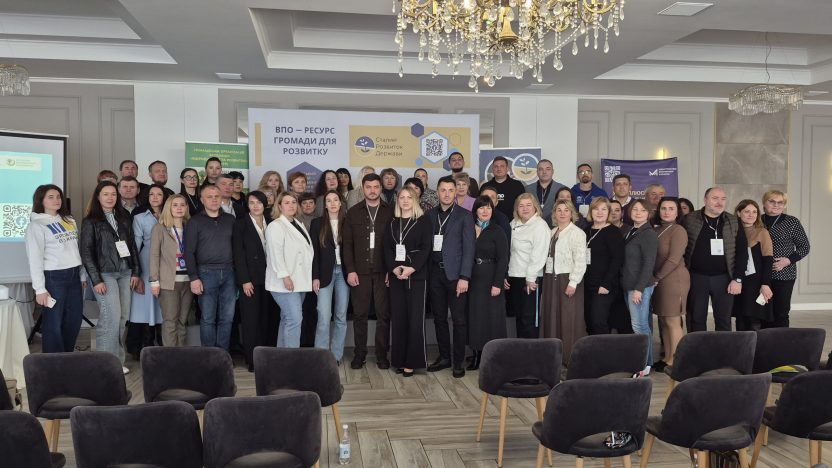
April 23, 2026, 12:09 p.m. 0 The Second Regional Conference of Councils on Internally Displaced Persons took place on April 21 in Cherkasy. Representatives of IDP Councils from local communities, regional and local authorities, and civil society organizations gathered to review the year’s work and outline common approaches to the integration of displaced persons. The event was organized by the NGO “Sustainable Development of the State” with the support of the International Renaissance Foundation.

There are 140,979 officially registered internally displaced persons in the Cherkasy region, 100,045 of whom have settled there permanently. Most are from the Donetsk and Kharkiv regions. Initially, about three million people passed through the region; some moved on, while others stayed. The main needs are housing and employment, followed by education and healthcare. The conference focused specifically on these four areas.
Forcibly Displaced Persons as Full-Fledged Residents of the Region
The region is moving beyond a humanitarian response: displaced persons are now considered full-fledged residents of the region.

“To us, they are already residents of Cherkasy. We want every economically active person to be employed,” said Natalia Kravchenko, First Deputy Head of the Cherkasy Regional State Administration.
Over two years of systematic work, the NGO “Sustainable Development of the State” has engaged with IDP Councils, reaching over 450 participants from more than 15 communities. The process began with training: council members were explained what their responsibilities entailed and where to focus their efforts. This was followed by workshops on fundraising, needs assessment, and project implementation.

“We’re shifting from asking ‘why isn’t it working, and where can we get funding’ to asking ‘what needs to be done now, and who will do it,’” concluded project manager Olesia Vorontsova.
One result of this approach is the employment of six people in public works in the Slobidsk community through the employment center: they weave camouflage nets and sew clothing for the military. Vorontsova emphasizes that all successful cases were made possible only through cooperation with regional and municipal authorities.
Systemic Changes and the Evolution of Advisory Bodies
For the International Renaissance Foundation, which funded both projects, this format is no coincidence. The foundation’s program manager, Viktoria Stokratyuk, noted that the simultaneous presence at the conference of representatives from government, the civil society sector, and IDP councils is the key indicator of success.

“We try not to just come in with some random project just for the sake of doing it. It’s important for us to make systemic changes at the community level,” she said.
At the same time, the councils themselves have evolved. The first term of the Regional Council for IDPs was a time of questioning—“Why are we even needed?” Now, the council drafts proposals for legislation regulating the activities of displaced persons. The updated membership includes representatives from civil society organizations and charitable foundations.

“These are people who wanted to make a difference without expecting anything in return for themselves,” said Vitalii Poltavets, head of the regional council’s IDP affairs committee.
The task now is to share this experience with councils in smaller communities.
Financial Support and Housing Challenges
In the city of Cherkasy, support for IDPs has developed in its own way. In 2022, 50,000 people passed through the city’s humanitarian headquarters. Today, 27,000 internally displaced persons live in the city. Cherkasy was the first city in Ukraine to introduce non-repayable financial support for entrepreneurs affected by shelling, and starting in 2023, it will reimburse the cost of generators and inverters for businesses.

“We are doing everything within the city government’s power. There is political will on the part of both the mayor and the city council,” said Deputy Mayor Maryna Harkava.
However, there is one issue the city cannot resolve on its own, namely housing. Cherkasy has a ready-to-go project for a new residential complex, the land, and the mayor’s support, but it still hasn’t made it onto the list of cities eligible to apply for state housing construction programs. Serhiy Ruban, director of the city council’s social policy department, confirmed this same problem:
— We are open, transparent, and as ready as possible to receive these resources.

He asked the participants to help establish communication with the military-civilian administrations of the occupied cities, as there are frozen development budgets there that could be redirected toward housing construction.
Garkava also asked the participants to share information about available European funds. Central regions of Ukraine are systematically excluded from such programs.
“Western Ukraine is included. For some reason, the center is being bypassed,” she noted.
Social Protection and Regional Support Programs
At the regional level, social support is more extensive. The region maintains an integrated social database on a daily basis. There are 35 temporary housing units, with plans to expand to 50. Over 400 people requiring constant external care are housed in residential care facilities. A separate regional support program for IDPs has been in effect since 2025—the 2026 budget totals 222 million UAH from all levels of government. Under the housing voucher program for IDP defenders: out of 1,091 applications submitted, 980 have been processed. Among the priorities are the creation of a social housing fund and the placement of an additional 4,500 people in need of support, said Ruslan Chikalo, head of the Department of Social Policy and Civil Protection of the Cherkasy Regional State Administration.

Labor Market: Grants, Training, and Employment Tools
In addition to housing, employment remains a key issue. The Employment Center funds community service and public works projects—the minimum rate is 8,640 UAH, which the agency can cover in full. Unemployment benefits are provided for three months, up to 8,647 UAH. When an IDP is hired, the center reimburses the employer for three months of salary; in cases of disability, six months. Grants for starting a business—from 200,000 to 8 million UAH, a training voucher—up to 33,000 UAH, and compensation for accommodation and travel. In 2025, over 1,000 displaced persons participated in the center’s programs, and more than 100 veterans became entrepreneurs.

“I’m confident we’ll find them a job within three months. But the person has to be willing,” said Oleksandr Dzhur, director of the regional employment center.
The Cherkasy City Council is simultaneously developing grant support mechanisms for veterans and their families—a significant portion of whom are also internally displaced persons. In addition, the city is updating its development strategy and is demanding that representatives of IDPs be included in the strategic committee.

“An outside perspective is very important. The experience of people who have developed their own cities and are now analyzing Cherkasy from a different angle,” explained Iryna Udod, director of the City Council’s Department of Economy and Development.
Economically active internally displaced persons as a community resource
At the same time, there is a group that is often overlooked in support efforts: economically active internally displaced persons. It was precisely this group that Olena Golovkina, head of development at the NGO “Association for Revival and Development,” emphasized.

“Eighty percent of people are employed and providing for their families. All attention is focused on vulnerable groups. But everyone gets tired,” she noted. “There are more people like this in the region than it seems.” In Zolotonosha, a displaced surgeon is seeing patients—there’s already a line to see him. In the Kalynopil community, a trauma surgeon is working, and people are traveling from Cherkasy to see him.
The Cherkasy Regional Development Agency notes: the region has gained specialists it has lacked for years, but has not yet learned to systematically engage them.

“When we were registering people in 2022, we didn’t look into who had arrived: whether they were doctors, economists, or project managers,” admitted Ilona Prykhodko, the agency’s director.
Golovkina echoed this sentiment: IDP councils should become a tool that connects such people with the community and the government.
“IDP councils are becoming a bridge between the government and the community. If we work together, the situation will change,” she concluded.
What is happening in Cherkasy Oblast is also being noticed from outside: organizations from western Ukraine, upon hearing about the local experience—the coordination center, the employment center, shelters, and the openness of the authorities—find it hard to believe.
“They say it can’t be true. I say: come visit, and we’ll show you,” added Golovkina.

This event is being implemented as part of the project “Strengthening IDP Councils in Cherkasy Region Communities: Training, Support, Networking” with the support of the International Renaissance Foundation.
The project partners are the IDP Council under the Cherkasy Regional State Administration, the Cherkasy Regional Development Agency, and the NGO “Association for Revival and Development.” This material was prepared with the support of the International Renaissance Foundation.
This material represents the authors’ views and does not necessarily reflect the position of the International Renaissance Foundation.
Source: Nova Doba

