

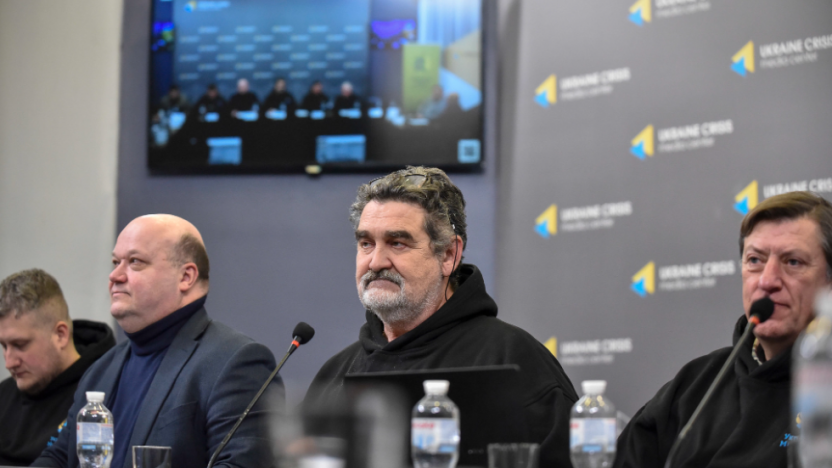
Ukraine enters 2026 with a mature, pragmatic vision of the Middle East. Russia no longer has a monopoly on influence in the region, and Ukraine’s success depends on consistency — a transition to a state strategy where diplomacy, economics, and truth become instruments of long-term influence. This was the conclusion reached by participants in the expert discussion “The Russian-Ukrainian War and the Arab World: Strategic Challenges of 2026,” organized by the Center for Middle East Studies (AMES) and the Ukrainian Crisis Media Center with the support of the International Renaissance Foundation.
The discussion was attended by the Chairman of the Board of the Ukrainian Crisis Media Center, Ambassador Extraordinary and Plenipotentiary Valery Chaly, Executive Director of the Center for Middle East Studies Ihor Semyvolos, Deputy Director of the Center for Middle East Studies Serhiy Danilov, Director of the National Institute for Strategic Studies Oleksandr Bogomolov, Head of the UCM Center’s Hybrid Threats Analysis Group Volodymyr Solovian, Editor-in-Chief of the Arabic-language website and YouTube channel “Ukraine Today,” Chairman of the NGO “Council of Arab Journalists in Ukraine” Mohammed Al-Aruki, Mohammed Zeidie, Head of the Syrian Community in Ukraine; Said Sallam, Head of the NGO “Vision Center for Strategic Studies”; Hossam Khalavani, Head of the NGO Center for Security and Peace; Ahmed Karnabi, representative of the Lebanese community in Ukraine.
During the discussion, it was noted that the Middle East region had moved from an emotional reaction at the start of full-scale war to harsh pragmatism and balancing of interests. For Ukraine, this means a change in approach: instead of appealing to sympathy, it must offer concrete security and economic solutions. Despite powerful Russian propaganda and a complex context (in particular, the war in Gaza), Ukraine not only maintained its position but also achieved diplomatic breakthroughs by effectively engaging diasporas as “proxy nodes” of influence.
An important success in 2025 was the restoration of relations with Syria after the fall of Bashar al-Assad’s regime. This case demonstrated effective interaction between the state and civil society: the Syrian diaspora in Ukraine became a key communicator with the new government. Agreements were reached on opening an embassy and launching Ukrainian business in the port of Tartus, which opens new “gates” to the Middle East for Ukraine and weakens Russian influence. The shared experience of Russian aggression became the foundation for rapprochement, while Moscow is losing trust due to memories of war crimes.
The overall diplomatic landscape remains complex: the UAE and Saudi Arabia are pursuing a policy of balancing. At the same time, the failure of the Russia-Arab World summit in October 2025 demonstrated Russia’s loss of status as an unrivalled centre of power and the unwillingness of Arab leaders to legitimise its global ambitions.
Economic relations in 2025 showed a “southern turnaround”: Ukraine’s agricultural exports to the markets of the Middle East and North Africa grew by about 60%. Egypt remains a key partner (about $1 billion in trade turnover for the first half of the year), and Algeria has become a record importer of Ukrainian wheat, confirming the priority of national interests over political declarations. At the same time, there are prospects for investment from the Gulf countries in the reconstruction of Ukraine and the transition to long-term economic planning.
The most difficult challenge remains the information front. Russia is actively waging a cognitive war, but Ukraine is responding asymmetrically — through “translation of meanings,” relying on diasporas and empathetic communication that appeals to human stories. Humanitarian diplomacy plays an important role: the mediation of Qatar, Saudi Arabia, and Kuwait in the release of prisoners and the return of deported children was a breakthrough and proved the effectiveness of humanitarian arguments.
Ihor Semyvolos: “The main conclusion of the year is that Russia has lost its status as an alternative pole of power. Our strategic goal is to move from situational trade, which we have demonstrated in principle by enabling the Middle East to survive these difficult years in complex situations, to a strategic partnership. Well, the foundation of everything is food security and investment in reconstruction. I would also note that Ukraine’s diplomatic presence in the Middle East has been reduced. As of now, we can say that all embassies operating in the region are full, i.e., ambassadors have been appointed, but we can also say that there was a pause in the appointment of some ambassadors, and this also affected the dynamics.
Oleksandr Bogomolov: “Ukraine, which essentially does not have its own fleet, defeated the Russian fleet, which had been, so to speak, a bogeyman for a long time, a driver of political tension throughout Ukraine’s independent history. And finally, the influence of the Russian fleet on the situation in the Black Sea region has now fallen to 30 percent of what it once was. And these success stories are very important in spreading our standards in the Arab world.”
Valery Chaly: “We see that the law of force constantly prevails. Small and medium-sized countries are becoming very vulnerable to the actions of the powerful. Therefore, we must unite to protect ourselves and seek common solutions, not based on the previous model of Israel versus the Arab countries. Not on this basis at all, but on the basis that there are non-nuclear and nuclear countries that claim to divide the world. There will be war in the coming decades; we must understand this. So we must unite so that we are not left behind in this division of the world. We have every opportunity to rebrand ourselves and rethink the situation. And I think today’s conversation is a very good contribution to this cause.”
Source: UKMC

