

The final phase of the project “Turn Up the Volume – From Voice to Action. Strengthening Communities Through Advocacy and Media,” implemented by the National Media Association as part of the “Impulse” Project, is currently underway. Civil society organizations, together with media partners, are finalizing their own advocacy and information campaigns in their communities, developed during training sessions. This is the stage where ideas are turned into concrete actions, and voices into influence on decisions.
The project brings together six civil society organizations from the Sumy, Odesa, and Kyiv regions and aims to strengthen the role of civil society through advocacy and media.
Throughout the year, the National Media Association works with the teams as a partner and expert—from the formation of an idea to its implementation. Participants have already completed training where they learned to identify problems, formulate goals, build a strategy for influence, and work with audiences.
At the same time, throughout the project, the Association’s experts help teams rethink the role of communication, integrate media into their campaigns, and use them not only to inform but also as an advocacy tool.
It is thanks to this work that advocacy initiatives gain a public voice, and issues important to the community get a chance to become part of local-level decisions. Today, we’re sharing the story of the civil society organization “Women of TRO” from the Kyiv region, which is already implementing its campaign in the community.
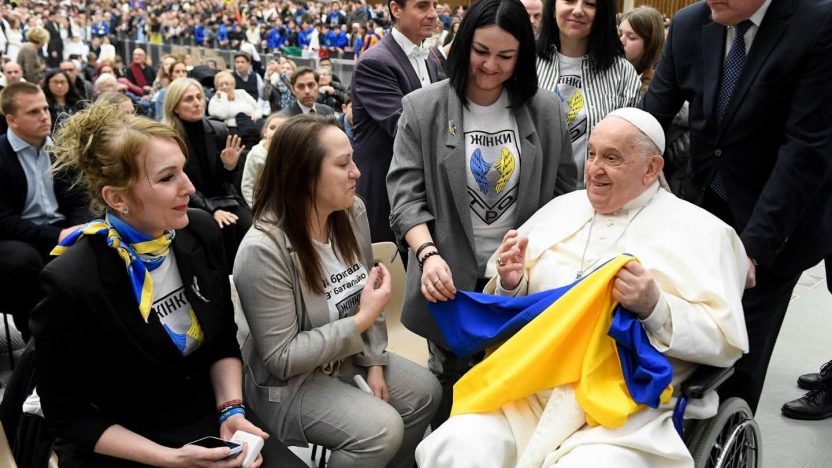
“Women of TRO” NGO: From Support to Community
Olena Skytiuk, chair of the board of the NGO “Women of TRO,” is working with her team on the advocacy initiative “The Voices of Families of Captured and Missing Defenders: Advocating for Dignity, Remembrance, and Mutual Support” as part of the “Turn Up the Volume—From Voice to Action” project.
This initiative focuses on people who are often left alone to cope with pain, uncertainty, and a lack of information. The main goal of the project is to create a space for support, interaction, and advocacy where every family can be heard. The key issue the team is addressing is the insufficient level of systemic support, communication, and representation of these families’ voices at the community and state levels.
Olena says this issue matters not only for the families themselves but for the entire community:
“This is important for the community because it fosters a culture of responsibility and unity, strengthens trust in institutions through open dialogue, and helps society remember that war is not just the front lines but also thousands of stories of waiting at home.”
Thanks to its participation in the “Turn Up the Volume” project, the team didn’t just make a name for itself—it was heard.
In particular, cooperation was strengthened with local authorities, the Department of Social and Veterans’ Policy, and the Department of Culture. With their support and co-organization, the team was able to implement an initiative important to the community—“Point of Support.” The team emphasizes that this was a project significantly broader in scope and impact than just an informational campaign:
“It wasn’t just an initiative. It was support that reached the people. The project covered not only the city of Boryspil but also the communities of Hlybok, Rohoziv, Ivankiv, Synkivka, Kuchakiv, and Liubartsi. In every settlement, the families of fallen, missing, and captured heroes received not just information—they received attention, support, and the feeling that they were not alone. Every family was heard. Everyone received the necessary contacts, assistance, and the opportunity to move forward without being alone with their grief. Local government provided transportation, and our partners, the NGO “Boryspil. Education. Culture. Sports.”—made a significant contribution by providing financial support for the project’s successful implementation.”
An important part of the campaign was the collaboration with our media partner, TRK “Boryspil.” As part of the project, the team established systematic cooperation that goes far beyond informational support: from creating content to fostering public dialogue on the topic.
As the team notes, this partnership has already yielded concrete results:
“Awareness of the issue has grown significantly at the community level, families’ voices have become louder and more influential, support has emerged from a wider circle of people, and the topic is no longer ‘silent’—it has become part of the public dialogue.”
Participation in the project, supported by the National Media Association, has significantly influenced the organization’s approach to its work and served as a growth opportunity for the team. They have redefined their role in advocacy and shifted from emotional appeals to more structured and strategic work.
In particular, the team learned to clearly articulate demands, work with target audiences, and strengthened their communication efforts—from crafting messages to selecting distribution channels. They paid special attention to systematic engagement with the media, viewing them not merely as a channel for information but as a tool for influence.
The most important outcome, says Olena, was the realization that a voice has power only when it is backed by concrete actions.
The “Turn Up the Volume” project is implemented by the National Media Association as part of the Impulse Project, which is carried out by the International Renaissance Foundation and the East Europe Foundation with funding from Norway (Norad) and Sweden (Sida). The content of this material does not necessarily reflect the views of the International Renaissance Foundation, the East Europe Foundation, the Government of Norway, or the Government of Sweden.

