


Since the start of the full-scale invasion, Ukraine’s southeastern region has remained one of the most dangerous areas, where fighting continues and cities and communities are regularly shelled. This creates new risks and constant uncertainty for people, affecting their safety, access to basic services, and the overall resilience of communities.
At the same time, frontline cities—both regional centers (Zaporizhzhia, Kherson, Mykolaiv) and small towns and villages—are developing their own practices for early recovery and strengthening resilience on a daily basis. This experience often remains localized, even though it could be useful for other communities as well.
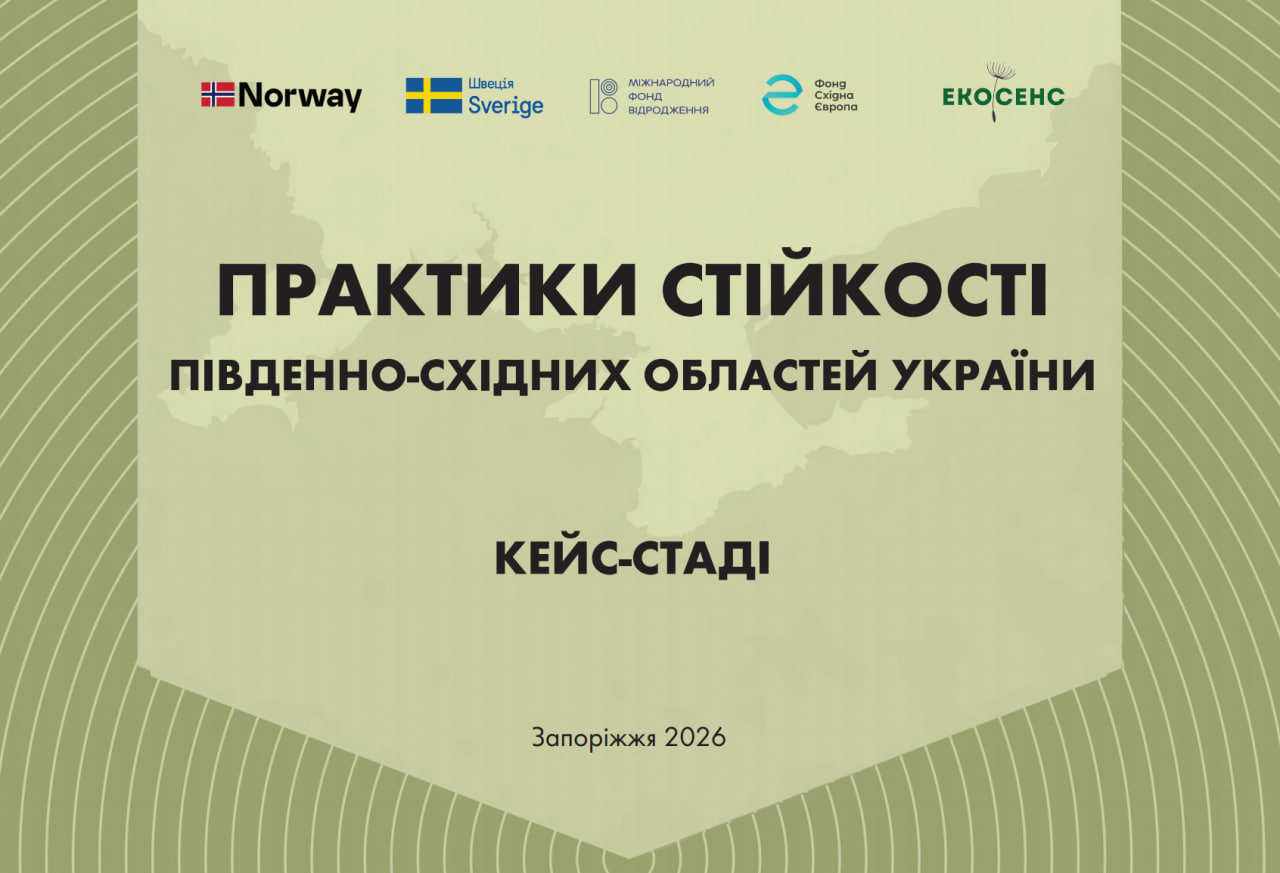
To scale up this experience, the NGO “Ecosense” has developed a case study titled “Resilience Practices in the Southeastern Regions of Ukraine.” The publication contains an analysis and summary of successful practices in early recovery, social cohesion, and community resilience implemented between 2024 and 2025 by local governments, civil society organizations, higher education institutions, businesses, and associations in the Zaporizhzhia, Mykolaiv, and Kherson regions. These case studies were presented at the Interregional Resilience Conference “Unbreakable Southeast,” which took place on December 12, 2025, in Zaporizhzhia.
This case study is intended for use by local governments, regional state and military administrations, civil society organizations, the media, business entities, and industry clusters, as well as international partners involved in early recovery and community development efforts aimed at strengthening societal resilience in wartime.
The selection of cases for the brochure was based on materials from speeches, interviews, presentations, and panel discussions at the “Unbreakable Southeast” Conference, as well as on previous analytical and programmatic materials from the organizers. The key selection criteria were the practicality of the solutions, their replicability in other local communities, and their cross-sectoral nature, which involves collaboration between government, civil society, business, and the expert community.
This publication compiles, analyzes, and summarizes successful cross-sectoral practices for maintaining resilience and early recovery in the Zaporizhzhia, Mykolaiv, and Kherson regions, with the aim of scaling them up; these practices will be useful for studying risk management and recovery.
A separate outcome of the conference, reflected in the brochure, is the development and presentation of the expert survey programme “Mapping the Risks to Social Resilience of Territorial Communities in Zaporizhzhia Oblast.” The methodology can be scaled for the study and management of social risks in various territorial communities not only in Ukraine, but also in European countries facing geopolitical challenges and military threats.
The conference also generated valuable experience related to the green recovery of cities in the South-East of Ukraine under conditions of climate change. Considerable attention was devoted to preserving economic resilience and supporting entrepreneurship during a prolonged war, particularly the role of business associations and cluster communities in this process, as well as opportunities for support from state institutions and government structures.
The involvement of broad circles of civil society, experts, academics, executive authorities, municipalities, territorial communities, and media representatives in exchanging practices of early recovery and sustainable development contributes to maintaining interest in European integration and strengthening the ecosystem of social resilience in these regions.
Thus, the publication accumulates managerial, expert, and civic practices of early recovery in South-Eastern Ukraine that are relevant to the conditions of full-scale war, to disseminate, analyse, and scale them.
The analysis of the cases presented during the conference and systematised in this brochure makes it possible to identify several shared principles without which resilience in frontline regions remains merely declarative.
Resilience is not formed within a single sector. None of the reviewed cases — from governance practices in large cities to specific economic or environmental initiatives — is the result of actions by a single actor. Effective solutions emerge at the intersection of cooperation and coordinated action between local self-government bodies, military administrations, businesses, civil society organisations, academia, and international partners. The absence of even one of these elements leads to fragmented efforts and reduced effectiveness.
A key condition for resilience is the presence of local leaders — both institutional and informal. This concerns not only official positions, but also the ability to take responsibility, make decisions under conditions of uncertainty, and maintain the trust of the community. The practices of Zaporizhzhia, Kherson, Mykolaiv Oblast, and individual communities demonstrate that local leadership ultimately determines whether resources and assistance are transformed into real change.
Resilience is impossible without a transition from intuitive to evidence-based governance. Risk mapping, digital governance platforms, analytical dashboards, and environmental community profiles are not auxiliary tools, but the foundation of decision-making. Data makes it possible to prioritise actions, work with limited resources, and engage with donors and state institutions in a substantiated and strategic way.
War does not eliminate long-term environmental and climate risks — it only intensifies them. Practices of energy resilience, climate-oriented planning, and the green modernisation of community infrastructure demonstrate that the environmental dimension is an integral component of security, economic viability, and quality of life. Ignoring this dimension creates deferred risks for recovery.
In frontline regions, businesses act not only as taxpayers, but also as co-creators of resilience. Small and medium-sized enterprises, united in clusters and working alongside business associations and civil society organisations, generate employment, support communities, and adapt to new markets and standards. Effective cases demonstrate that partnerships between businesses and communities are mutually beneficial and critically important for early recovery.
Recommendations for Strengthening Resilience
Based on the analysis and synthesis of the described solutions and practices of community functioning under conditions of frontline proximity and constant military threats, the analytical group of the NGO “Ecosense” has developed the following recommendations for strengthening resilience and preserving sustainable development.
For territorial communities:
- Based on the analysis of successful cases from communities and actors in South-Eastern Ukraine, optimise policies and practices of early recovery.
- Institutionalise cross-sectoral cooperation through permanent collaboration platforms involving businesses, civil society organisations, and experts.
- Introduce systematic risk mapping as the foundation for planning and budget priorities.
- Invest in human capital, local leaders, and professional management teams.
- Integrate environmental and climate considerations into development and recovery strategies.
For military-civil administrations:
- Strengthen “everyday” participatory democracy through advisory and consultative bodies, public consultations, public hearings, local initiatives, residents’ assemblies, public expertise, and support for informal interaction formats (community clean-ups, mini-projects, volunteer initiatives, civic actions, and cohesion spaces).
- Ensure coordination between communities and reduce the fragmentation of governance decisions.
- Support the creation of regional analytical and digital governance tools.
- Promote кадрова stability and the professionalisation of public service under wartime conditions.
- Act as moderators of partnerships between communities, businesses, and donors.
For donors and international partners:
- Focus support on long-term institutional capacity rather than only rapid infrastructure results.
- Support projects that combine security, economic, and social objectives with sustainable development goals.
- Use the results of risk mapping as a basis for funding prioritisation.
- Invest in local development institutions, agencies, hubs, and professional teams.
For business:
- View participation in recovery as a strategic investment in the stability of the operating environment.
- Form clusters and business communities to reduce risks and gain shared access to resources.
- Integrate social and environmental responsibility into business models.
- Work in partnership with local self-government bodies and authorities to support community development and recovery, moving beyond short-term benefits toward strategic goals.
This publication was prepared by the NGO “Ecosense” as part of the implementation of the project “Interregional Resilience Conference ‘Unbreakable South-East’,” which is part of The Impulse Project, implemented by the International Renaissance Foundation and East Europe Foundation with funding from Norway (Norad) and Sweden (Sida). The content of this material does not necessarily reflect the position of the International Renaissance Foundation, East Europe Foundation, the Government of Norway, or the Government of Sweden.
Source: https://vidnova.info/

