How to Support the Recovery of IDPs from Donetsk and Luhansk Regions: A Study Was Presented and a Discussion Held in Kyiv
To promote integration in their new location while maintaining IDPs’ ties to their home communities, the government, local self-government bodies, international funds, and the civil society sector must strengthen the social and communication components of their programs and initiatives. This conclusion was reached by participants at the event “How to Strengthen the Role of IDPs from Donetsk and Luhansk Regions in Recovery,” which took place on July 22 in Kyiv as part of the “Impulse” project.
Why These Issues Are Urgent
Oleksiy Orlovsky, director of the “Democracy and Good Governance” program at the International Renaissance Foundation, emphasized in his opening remarks that people and the restoration of social capital must be the state’s top priority today. He cited a telling example: at one of the Foundation’s events in Cherkasy Oblast, a participant interpreted the acronym IDP as “internally abandoned persons.”
“This was a poignant and very important hint that changes are needed in state policy regarding internally displaced persons,” emphasized Oleksiy Orlovsky.
A Study That Resonated with the Audience
During the event, the results of the study “Map of Problems and Solutions: IDP Experiences and Institutional Perspectives on Recovery” were presented. It was conducted by the NGOs “Eastern Variant” and “Window of Recovery” as part of the project “Rebuilding the East: Dialogue for the Future.”
One of the authors’ recommendations is to define the acronym IDP not as “internally” but as “forcibly displaced persons.” This point was emphasized by participants in focus group discussions held in January 2026, which included more than 60 internally displaced persons, as well as representatives of government, the media, and civil society organizations. Participants at the event in Kyiv on July 22 also noted this.

According to Alla Petrenko-Lysak, the author of the analytical report and a candidate of sociological sciences, the very word “recovery” sounds abstract to many focus group participants, as it is a fairly common term in the media and in official documents. But what matters most to people is, first and foremost, their own recovery—regaining their sense of self-sufficiency and rebuilding severed social ties. The study revealed a demand for platforms for dialogue, as the focus groups—in addition to their research function—served as a kind of therapeutic setting for mutual support.
“IDPs want to be seen as more than just displaced people,” said Karina Popova, a journalist for “Windows of Recovery,” discussing another finding of the study.
Forcibly displaced people need their agency to be recognized. An individualized approach that takes into account age, professional experience, and other factors will help in this regard.

Therefore, the authors of the report recommend:
- transforming universal programs for IDPs into category-specific programs;
- developing protocols for intensive onboarding of IDPs, especially for young people.
These and other recommendations for national and local authorities, donors, civil society organizations, and the media were also discussed and refined at the event in Kyiv.
Challenges and Case Studies
The event also featured a panel discussion titled “Integration of Internally Displaced Persons and Its Impact on Recovery: Challenges and Case Studies.”
Vladyslav Zakabluk, Deputy Director of the Department and Head of the IDP Rights Division within the Department for Monitoring the Observance of the Rights of Citizens Affected by the Armed Aggression Against Ukraine at the Office of the Ombudsman of Ukraine, emphasized: “The recommendations provided by the Office of the Ombudsman and those in your study are, in fact, very similar. We also raise the issue of the need to involve IDPs in the development, adoption, and implementation of local support programs for internally displaced persons.”
According to Vladislav Zakabluk, the implementation of the recently adopted strategy on IDPs for the period up to 2030—at both the national and local levels—is under constant monitoring by the Human Rights Commissioner.
Natalia Petrenko, head of the Shulhynska Rural Military Administration in Luhansk Oblast, pointed out that the potential of communities that were forced to relocate is not being fully utilized. According to her, the civil society sector is sometimes more influential than such local self-government bodies.

Tetyana Horbatyuk, deputy director of the Department of Social and Veterans’ Policy at the Rivne City Council, cited examples of effective solutions. The city has a targeted program for the integration of internally displaced persons (IDPs).
“One of the most effective measures to support employment for our IDPs is the refund of a portion of the taxes they’ve paid,” said Tetyana Horbatyuk.
In addition, Rivne has emergency response teams that proactively assist evacuated citizens rather than waiting for them to reach out.
Valeria Krupoderia, hotline coordinator and project manager for the Donetsk and Luhansk media outlet “Eastern Variant,” spoke about the complexity and multifaceted nature of the issues raised with their media outlet by residents of the temporarily occupied territories and areas on the front lines.
Karina Popova, a journalist for “Windows of Recovery,” noted that in her reporting she tries to portray IDPs not as recipients of aid, but as people who create jobs and pay taxes. Yet it is equally important to report on the challenges and difficulties IDPs face after evacuation.
Yaroslav Taranets, team lead of the advocacy division at the “Sхід SOS” Charitable Foundation, explained that evacuation remains one of the most pressing and complexніших напрямів діяльності фонду, особливо коли йдеться про вразливі категорії людей.

Reviewing Key Routes
In addition to the discussions—which, according to audience feedback, fostered a sense of belonging to the community—the event also featured a facilitated session.

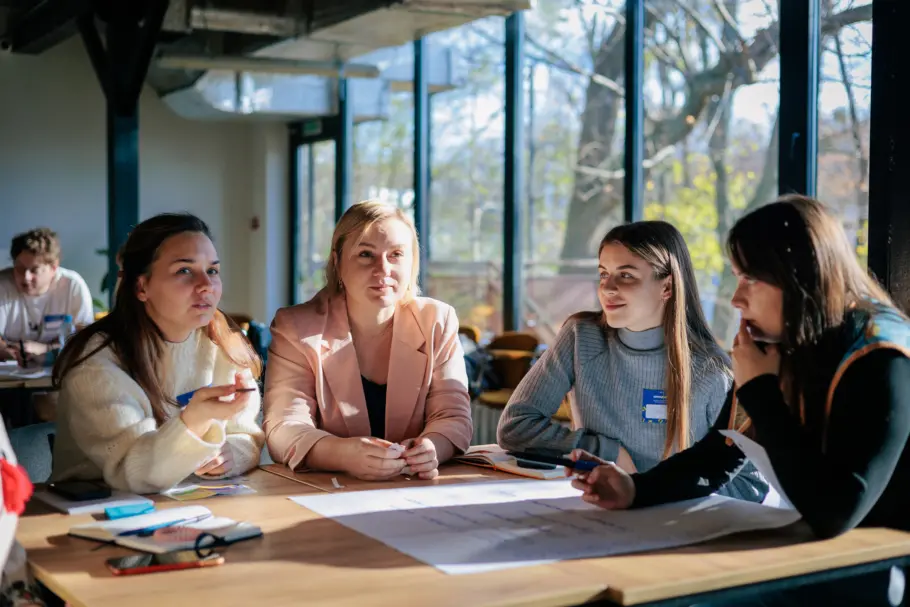
In a game-like format, moderated by sociologist Alla Petrenko-Lysak, participants mapped out the paths of characters—internally displaced persons—in their new communities. They identified the most conflict-prone and sensitive areas, as well as “places of strength” and healing. In addition, they envisioned what new institutions or locations the community would need so that a new resident’s potential could be fully realized. It is noteworthy that all groups of participants depicted success stories for their IDPs. This means that even in real-life situations of forced displacement, it is precisely joint efforts and a well-thought-out approach that will ensure successful integration.
The event’s media partners included Bakhmut IN.UA, Free Radio, Hromadske Radio, Socportal, Donbas News, LB.ua, Rubryka, Kramatorsk Post, the NGO “It Makes Sense,” the “On the Line of Contact” coalition, and the Anti-Crisis Media Center.
This material was prepared as part of the “Impulse” Project, implemented by the International Renaissance Foundation and the Eastern Europe Foundation with funding from Norway (Norad) and Sweden (Sida). The content of this material does not necessarily reflect the views of the International Renaissance Foundation, the Eastern Europe Foundation, the Government of Norway, or the Government of Sweden.
Source: Window of Recovery