

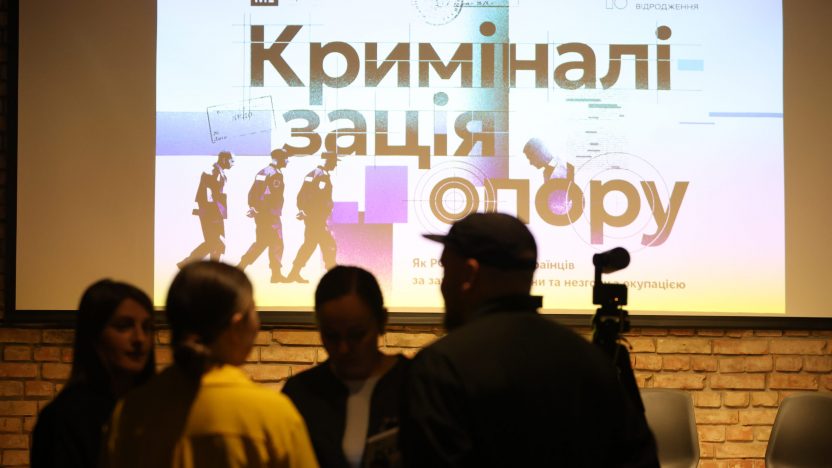
The Media Initiative for Human Rights presented a report titled “Criminalizing Resistance: How Russia Persecutes Ukrainians for Defending Their Homeland and Opposing the Occupation.” During the event, human rights activists, law enforcement officials, and soldiers released from captivity spoke about how Russia uses its own judicial system to repress Ukrainian prisoners of war and civilians. Here are the key takeaways from the presentation and the study.

“I was convicted for my imagination and ingenuity,” jokes Vladislav Andrianov, a soldier with the 1st Corps of the National Guard of Ukraine’s “Azov” unit. By “resourcefulness,” he means the alleged war crime he committed—one he invented for himself. Vladislav is one of the lucky few who managed to return from Russian captivity. Before that, however, the Russians sentenced him to 25 years in prison.

Here’s how it happens: when a Ukrainian soldier is taken prisoner, they begin to torture, intimidate, and blackmail him. At the same time, they persistently urge him to switch sides to Russia, admit to certain crimes, and forget that he is Ukrainian and fought for Ukraine. As soon as the prisoner agrees, the torture stops.
— Every time during the torture, they told me: “Confess to the crimes you committed, and it will all stop.” At some point, I got so tired of the torture that I made up a story about how I supposedly killed a civilian. I thought it through in every detail so as not to frame anyone. The plan was to tell it when I no longer had the strength to endure. I held out for a year and a half, and then I gave in and told my story. As soon as I “confessed,” they became interested and stopped torturing me,” says the Azov soldier.
The murder case contained neither witnesses, nor evidence, nor a body—only Vladislav’s testimony and a record of the investigative experiment. The judge presiding over the court hearing (the only one in the case) gestured to the defendant that he was the one who had to answer. When the lawyer assigned to Andrianov (usually a mere formality) told the judge that the case contained no evidence, the judge hinted that the lawyer should not “whitewash the crimes of the Nazis.” The lawyer agreed and made no further comments.

After his sentencing, Vladislav no longer saw the other Ukrainian prisoners. Instead, according to him, he was held in prison with Russian murderers, cannibals, and leaders of criminal gangs.
Another Ukrainian prisoner, Serhiy Benza, a former commander of the fire support company of the 36th Marine Brigade’s marine battalion, had the same company in Penal Colony No. 6, “Black Dolphin.” If Serhiy hadn’t been released in one of the prisoner exchanges, he might have remained there forever. His sentence for allegedly ordering the shooting of civilians carried a life sentence.
— Of course, everyone knew perfectly well that this didn’t happen [the shooting of civilians]. At first, I resisted the charges, but eventually “confessed.” This is how they do it: they call in a “witness,” take him into the next room, and torture him, while I hear everything happening behind the wall. And you confess so that they stop torturing that person. People can hold out for a very long time; many of them are still holding out. But they put pressure on our sense of humanity. They use collective punishment, just like in the USSR, because they know we can’t withstand it,” explains Serhiy.

Just like in Vladislav’s case, Sergei’s trial was purely a formality and riddled with procedural violations, the man says. The sentences were read out quietly and quickly—Sergei’s cellmate didn’t even understand what sentence he had been given. Immediately after the trial, Sergei was forced to sign a waiver of his right to appeal.
But despite the absurdity of these trials, they pose a huge threat to us and the world, and require investigation, public attention, and effective countermeasures.
What is the threat?
These are not isolated cases of cruelty or abuse, but a large-scale and centralized system of persecution against Ukrainians. As of May 2026, the Media Initiative for Human Rights has documented 2,441 cases of criminal prosecution by Russia of Ukrainian prisoners of war and civilians. Over 1,700 of these cases have resulted in convictions.

This isn’t just about military personnel. Russia is persecuting civilians for volunteering, aiding the Ukrainian army, taking a pro-Ukrainian stance, making donations, managing Telegram channels, or simply showing disloyalty to the occupation. People are accused of “terrorism,” “extremism,” “espionage,” or “treason” and sentenced to decades in prison.
According to Anna Rassamakhina, head of the “War and Justice” department at the International Institute for Human Rights (IIHR), an analysis of these cases shows that all Russian agencies operate as a single mechanism.
“When examining the testimonies of prisoners and civilians, we see that all Russian agencies work in a highly coordinated manner to fabricate these cases. They pass these cases down the chain, and no one at any stage raises any questions. Everyone knows perfectly well that without torture, there would be no convictions,” she says.

According to Rassamahina, this system operates both throughout Russia and in the Ukrainian territories it occupies.
One of the main problems is Russia’s complete disregard for international humanitarian law, particularly the immunity of combatants, which means that a soldier cannot be punished simply for participating in hostilities on behalf of their state.
“The Russian Federation finds Ukrainian soldiers guilty solely on the basis that they are military personnel and participated in an armed conflict,” explains the human rights activist.
At the same time, the Russian system contradicts itself. Ukrainian soldiers are accused of using prohibited methods of warfare, while at the same time it is claimed that the war against Ukraine is allegedly not an international armed conflict, but merely a “special military operation.”
— It is difficult to find any standards being upheld in these trials. Absolutely everything is being violated,” emphasizes Anna Rassamakhina.
At the same time, she stresses that despite the obvious absurdity of such trials, they should not be underestimated:
“This is a very poor imitation of justice, but these are still verdicts handed down by the official courts of a state recognized by the international community. And therein lies the main danger.”

The lawyer explains that to people and countries not immersed in the context of the Russian-Ukrainian war, these trials may appear to be genuine criminal cases involving war crimes committed by Ukrainian military personnel. That is precisely why Ukraine must not only document the violations but also thoroughly examine Russian court rulings so that it has arguments at the international level to counter attempts to legitimize these rulings.
Tetyana Katrychenko, head of the International Institute for Human Rights, emphasizes that this is not just about documenting crimes.
“Ukraine must work on several fronts simultaneously: hold accountable those involved in persecution, challenge and nullify the decisions of Russian and occupying quasi-courts, and prevent their international legitimization,” she explains.

Andriy Atamanchuk, a representative of the Office of the Prosecutor General, also spoke about the complexity of this process.
“These cases aren’t something that can be resolved in a year or two. They are long-term cases,” he notes.
As of today, Atamanchuk says, 30 representatives of law enforcement and judicial bodies of the Russian Federation or quasi-legal institutions in the occupied territories have been charged, and 11 indictments against 18 individuals have been filed with Ukrainian courts. Additionally, the Shevchenkivskyi District Court of Kyiv recently handed down the first verdict against a Russian judge for violating the right to a fair trial.
“This line of work presents challenges for Ukrainian law enforcement. However, the scale of the crime indicates a systematic pattern, and thus reflects the Russian Federation’s policy regarding the criminal prosecution of Ukrainians. Therefore, we will strive to establish this chain of accountability all the way up to the Russian leadership,” the prosecutor noted.

At the same time, he emphasized that even in response to Russian crimes, Ukraine cannot abandon the principles of international law. This, after all, is one of the key differences in the approaches to justice between Ukraine and Russia. While the Russian state uses courts as an extension of its torture chambers, Ukraine seeks justice within the bounds of the law—even when its adversary completely disregards that law.
For more details on the study, follow the link:
This material was prepared with the support of the International Renaissance Foundation. The material represents the authors’ views and does not necessarily reflect the position of the International Renaissance Foundation.
Source: Media Initiative on Human Rights

