

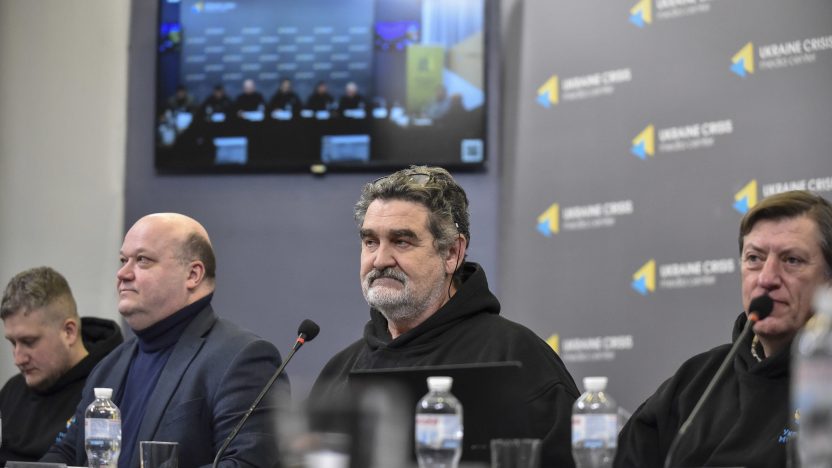
Recently, the Ukrainian Crisis Media Center hosted a landmark professional discussion organized by the https://uames.org.ua with the support of the International Renaissance Foundation. The topic of the meeting, “The Russian-Ukrainian War and the Arab World: Strategic Challenges of 2026,” brought together leading Ukrainian diplomats, experts, and leaders of Arab diasporas to take stock of the pivotal year of 2025.
This conversation is important not only because of the need to take stock of achievements, but also because of a fundamental paradigm shift in relations. As the participants noted, the Middle East region has moved from a stage of situational emotional reaction at the beginning of the invasion to a phase of tough pragmatism and balancing of interests. For Ukraine, this means the need to rethink its role: we can no longer rely solely on sympathy, but must offer concrete security and economic solutions. The key theme of the meeting was the realization that, despite powerful Russian propaganda and a complex geopolitical context (in particular, the war in Gaza), Ukraine has not only managed to maintain its position but also to achieve a number of diplomatic breakthroughs, transforming diasporas into effective “proxy nodes” of influence.
Diplomatic breakthrough: the Syrian case and new gates to the Middle East
One of the most notable successes of Ukrainian diplomacy in 2025 was the restoration of relations with Syria, which became possible after the collapse of Bashar al-Assad’s regime. The participants in the discussion called this case a textbook example of effective interaction between the state and civil society. The Syrian diaspora in Ukraine, which experts dubbed “agents of change,” played a critically important role as communicators with the new government in Damascus.
Thanks to the efforts of Ukrainian-Syrian entrepreneurs and activists, it was possible not only to restore diplomatic contacts, but also to reach agreements on opening an embassy and starting Ukrainian business operations in the port of Tartus. This is a strategic victory that opens new “gates” to the Middle East for Ukraine and creates opportunities to displace Russian influence in the region.
At the same time, the overall diplomatic landscape remains complex. Most Arab countries (the UAE, Saudi Arabia) continue to pursue a policy of balancing, prioritizing stability and their own national interests. However, the failure of the Russia-Arab World summit planned by Russia for October 2025 demonstrated that Moscow has lost its status as the only pole of power, and Arab leaders have refused to legitimize Putin’s global ambitions.
Economic pragmatism: the “southern shift” and food security
The economic component of relations in 2025 showed impressive dynamics, which experts called the “southern shift.” Against the backdrop of the restoration of quotas and restrictions by the European Union, Ukrainian agricultural exports reoriented themselves toward the markets of the Middle East and North Africa (growth was about 60%).
Ukraine has successfully secured its status as a guarantor of food security in the region. Egypt remains a key partner with a trade turnover of about $1 billion for the first half of the year, and Algeria, despite its traditionally pro-Russian political sentiments, has become a record importer of Ukrainian wheat (739,000 tons). This confirms the thesis that national interests and the need for bread prevail over political declarations.
In addition to trade, there are prospects for attracting investment from the Gulf countries (UAE, Saudi Arabia) in the reconstruction of Ukraine. Discussions on preferential trade agreements and the creation of grain hubs indicate a transition from situational trade to long-term planning. Successful cases, such as the interest of UAE funds in Ukrainian assets, prove that Arab capital is ready to enter Ukraine without waiting for the formal end of the war.
Information warfare: empathy versus propaganda and the role of soft power
The information front remains the most difficult challenge. Russia is investing enormous resources in cognitive warfare, using narratives about the West’s “double standards” regarding Gaza and Ukraine, as well as planning large-scale training for Arab journalists through RT Academy. However, Ukraine has found an asymmetric response — “translating meanings” instead of simply translating language.
Diasporas and projects such as the Ukrainian-Arab Media Group have become key tools. Experience has shown that dry facts lose out to emotional stories. Therefore, Ukrainian communication has shifted toward empathy — stories about the war through human destinies that resonate with the experience of the Arab audience. The Lebanese community plays a special role, cementing Ukraine’s presence in the cultural space through cultural diplomacy (erecting a monument to Shevchenko, publishing books).
Humanitarian diplomacy has been an important achievement. The mediation of Qatar, Saudi Arabia, and Kuwait in the release of prisoners and the return of deported children (supported by 91 votes in the UN) was a breakthrough that allowed Ukraine to break through the wall of neutrality. This proves that humanitarian and religious arguments work better than dry geopolitical rhetoric.
Conclusion
To sum up the discussion, it can be said that Ukraine is entering 2026 with a new, more mature understanding of the Middle East. We are getting rid of illusions about automatic support and learning to play on the field of pragmatism. The main strategic conclusion is that Russia no longer has a monopoly on influence in the region, and its narratives can be effectively dismantled through truth, empathy, and economic cooperation.
During the discussion, Valery Chaly, Chairman of the Board of the Ukrainian Crisis Media Center and Ambassador Extraordinary and Plenipotentiary, noted: “We see that the right of force constantly prevails. Small and medium-sized countries are becoming very vulnerable to the actions of the powerful. Therefore, we must unite to protect ourselves and seek common solutions not on the basis of what was before: for Israel, against Arab countries. Not on this basis at all, but on the basis that there are non-nuclear and nuclear countries that claim to divide the world. War is inevitable in the coming decades — this must be understood. Therefore, we must unite so that we are not left behind in this division of the world. We have every opportunity to rebrand ourselves and rethink the situation. And I think that today’s conversation is a very good contribution to this cause.”
Ukraine’s success in the Arab world now depends on consistency: a transition from volunteer efforts to a state strategy, where every ambassador is an active spokesperson and every ton of grain is an instrument of influence. As noted by Alexander Bogomolov, director of the National Institute for Strategic Studies, this is a war of attrition not only on the battlefield but also in the cognitive space, where victory goes to those who never tire of repeating the truth. The year 2026 should be the year when Ukraine’s status is consolidated not as a beggar for help, but as an integral element of the security architecture — from food to geopolitical.
Source: Black Sea News

