

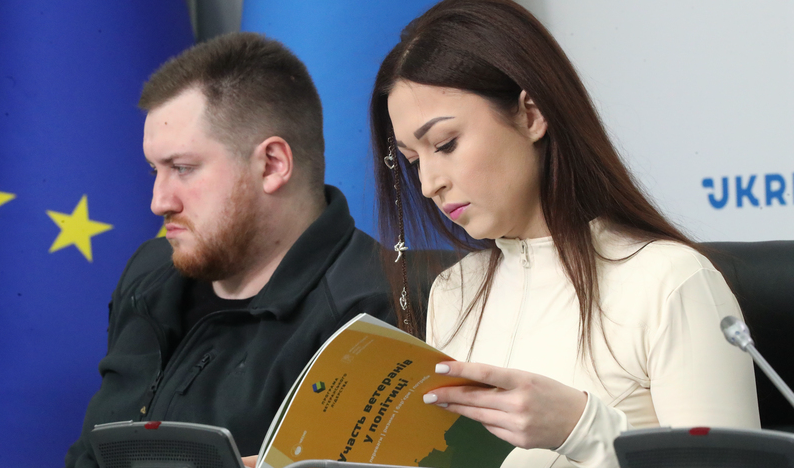
The CHESNO movement, as part of the Veteran Leadership Program and with the support of the International Renaissance Foundation, conducted a study on the benefits, risks, barriers, and needs of veterans in terms of political participation. CHESNO presents all of this in its report, “Veteran Participation in Politics: Benefits | Risks | Barriers | Needs.”
The study considered participation in political life not only as participation in the electoral process, but also in a broader sense—as a personal contribution to the decision-making process, and veterans themselves as combatants who have been discharged from the Security and Defense Forces or continue to serve in the military.
Veterans already constitute a large social group, numbering 1.5 million people, and this number is expected to grow to 6 million in the future. The experience of other countries shows that veterans have played a significant role in political processes over the years. Veterans are expected to form a new generation of leaders focused on responsibility and strategic thinking, reducing bureaucracy and speeding up decision-making, as well as strengthening the state and increasing trust. However, combat experience alone does not guarantee political success, and there is a significant risk of the “veteran brand” being used to win the favor of the electorate and improve the reputation of political forces.
In order to identify barriers, needs, and incentives for veterans’ political participation and to assess the readiness of political and state institutions to engage veterans, an analysis of legislation, Ukrainian and international practices, 14 in-depth interviews with politicians, experts, and veterans, and a nationwide survey of 2,001 adult residents of Ukraine from government-controlled territories conducted by the Kyiv International Institute of Sociology.
Based on this, a framework document was prepared that contains society’s expectations for the active political participation of veterans and outlines the potential risks commensurate with the risks of participation by any other social group. The document identifies potential barriers to the political participation of veterans, describing the views of key stakeholders and the electorate, as well as ways to reduce and overcome these barriers, and recommendations for state institutions, political parties, the public sector, and international partners for developing the political capacity of veterans.
Barriers to veterans’ participation in political life are complex and manifest themselves at various levels — from personal and social to institutional and financial — and one of the main ways to overcome them is through education, which allows them to gain the necessary knowledge, strengthen their motivation, and develop their own capacities and those of the community.
In principle, there are no legal restrictions on demobilized veterans participating in political life, but there are some restrictions on active military personnel.
Veterans see themselves as legitimate political actors, and society sees them as having the potential to renew the political elite. However, without investment in professional education and resource sustainability, this potential risks remaining unrealized or being used for short-term political PR.
The full report by the CHESNO Movement is available at the link.
Source: CHESNO

