A study titled “Documenting the Russian-Ukrainian War, 2014–2025” was presented in Kyiv
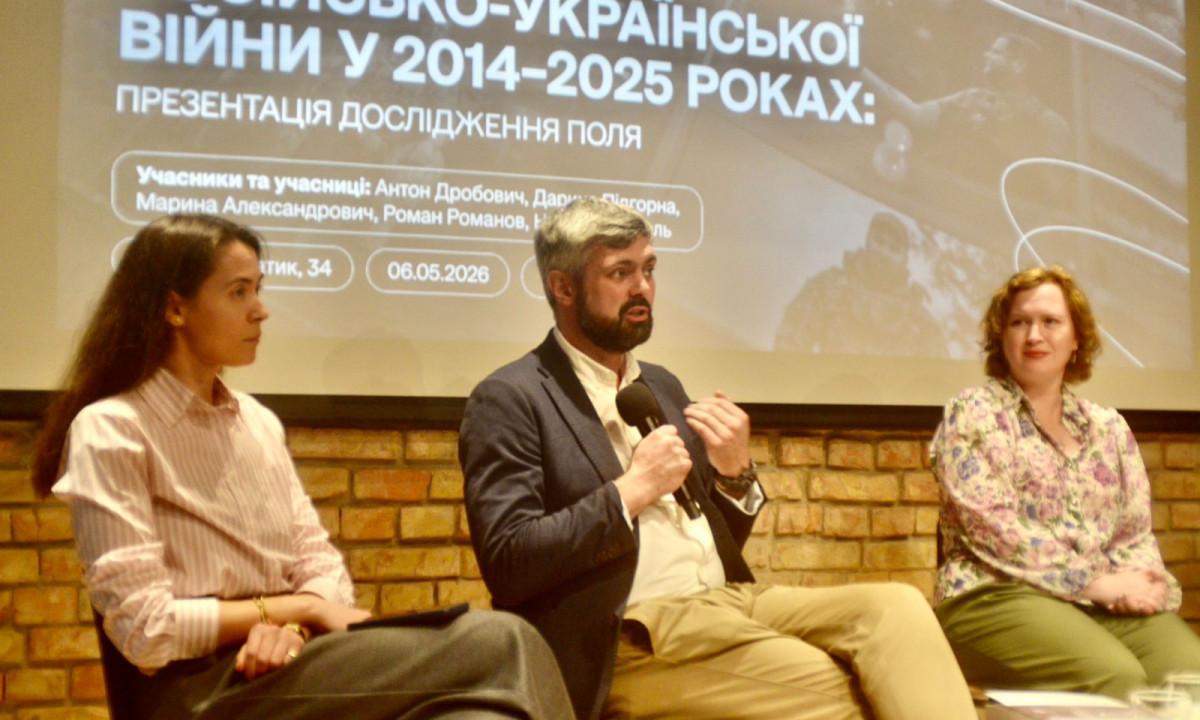
On May 6, the Center for Human Rights and War Memorialization at the Kyiv School of Economics (KSE) presented its study, “Documenting the Russian-Ukrainian War, 2014–2025,” at the “Sens” bookstore on Khreshchatyk. Anton Drobovich, the founder and director of the Center, as well as a public and government figure, spoke to “Detector Media” about this.
The presentation was moderated by Daria Sviridova. The event was attended by the study’s authors—Anton Drobovich, Daria Pidhorna, and Marina Aleksandrovich—reviewer Natalia Handel, as well as Roman Romanov, a representative of the International Renaissance Foundation, with whose support the study was prepared and published.
“Roman spoke about the challenges of documentation and the importance of cataloging, because the question of the ultimate purpose of all this documentation is increasingly being raised—how it will be used in the process of achieving justice, not only in the context of transitional or restorative justice, but also in general: what is the state’s logic. Such catalogs are helpful in answering these questions,” shared Anton Drobovich.
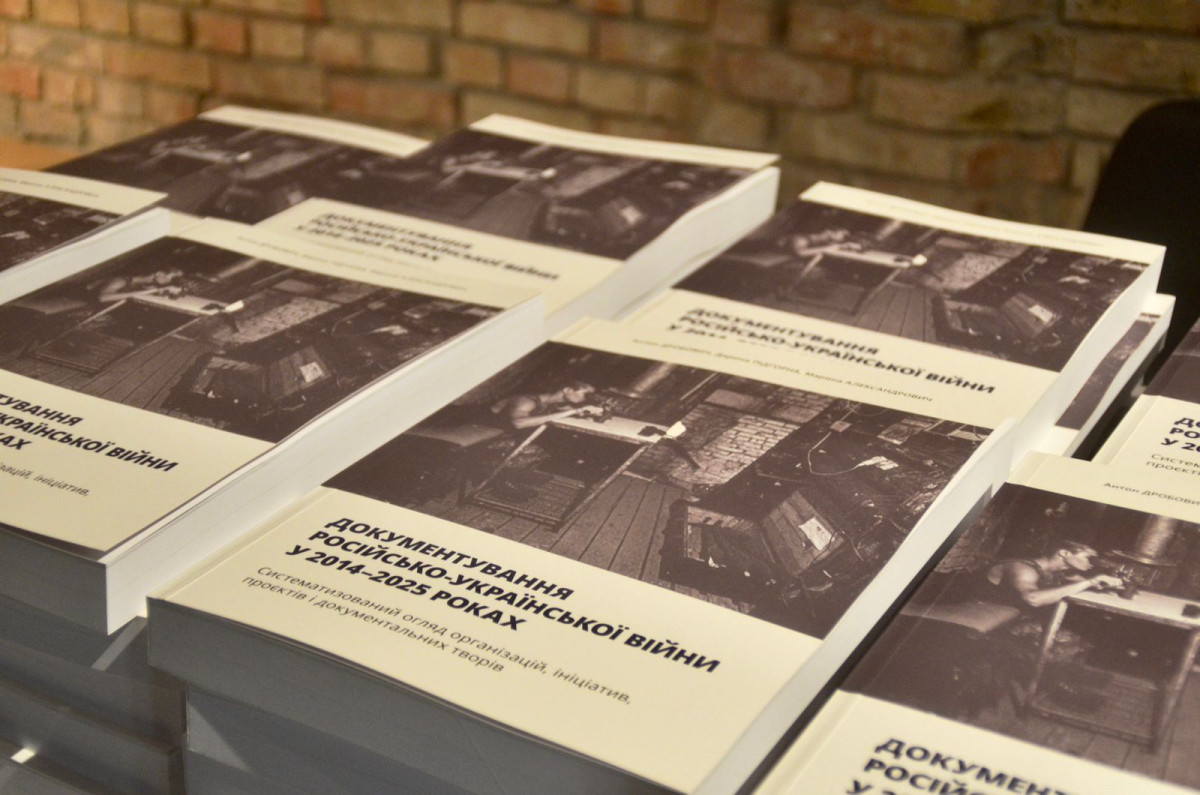
In its study, the Center for Human Rights and War Memorialization analyzed 90 organizations and initiatives, as well as 114 projects and works documenting the Russian-Ukrainian war. The study is currently available in two formats—digital and print.
“The physical version was published in a limited print run, which we distributed to organizations involved in documentation, as well as to university libraries. Since the study is highly specialized, it is generally not intended for a broad audience. The content of the PDF version is identical. It’s even slightly better because the projects in the list are linked: you can click and go to the website to see what it looks like,” Drobovych explained.
According to him, what sets this study apart is that it introduces a new typology of documentation comprising 10 types, including basic types (preservation and descriptive) as well as synthetic types (legal, historical, journalistic, OSINT documentation, etc.).
“An English version of this study is currently being prepared for publication; it will also be released in both print and PDF formats and distributed to key law schools, libraries, and organizations involved in transitional justice, military documentation, and so on, to gather feedback. The first stage of the study is the publication we are discussing. The second is the English version and its global distribution. Next, we will collect feedback and, by the end of 2026, design a comprehensive study,” said Anton Drobovich.
He also noted that even at this stage, the research has confirmed that Ukraine possesses all the prerequisites for establishing a community of documentarians.
“It’s hard to say right now whether this is the field of documentation or a documentary landscape. On the one hand, there is a coalition, including human rights organizations. There are several platforms—such as the symposium in Lviv titled ‘The Most Documented War’—that help foster a community, but there is a lack of ethical standards and guidelines regarding the red lines of documentation. Over these 12 years, a fantastic amount of work has been done by a huge number of people and organizations. The initiatives vary quite a bit in terms of quality and content. We didn’t evaluate them because our task was to map out this field,” Drobovych shared.
Among the organizations included in the study are, in particular, “Detector Media,” the Institute of Mass Information, the Public Interest Journalism Lab, the Crimean Human Rights Group, the Main Intelligence Directorate of the Ministry of Defense, “Slidstvo.Info,” “Ukrainska Pravda,” “Babel,” Public Broadcasting, the Ukrainian Institute of National Remembrance, the Museum of the History of Kyiv, the Zmina Human Rights Center, Hromadske, Docudays UA, Bihus.Info, LB.ua, Kyiv Independent, The Ukrainians Media, Ukraїner, and others.
According to Drobovych, they were selected based on the following principle:
“It was important for us to find out what organizations exist, which ones have websites or resources where we could go and view a list of documentary projects. We tried to focus primarily on the largest ones. However, whenever we came across smaller initiatives, we also took them into account and added them to the profile. Of course, this is not an exhaustive list. We are aware of this, and in one of the sections, we included a feedback form so that we can take everything into account as much as possible by the third stage of the research.”
The projects and documentary works were selected based on popularity and with a view to representing various types of documentation. Thus, the study included: Mstislav Chernov’s films *20 Days in Mariupol* and *2,000 Meters to Andriivka*, Maxim Kryvtsov’s poetry collection “Poems from the Loopholes,” Tamara Gorikha Zernia’s novel “Dotya,” Artur Dron’s short story “Hemingway Knows Nothing,” Anastasia Falileeva’s animated film “I Died in Irpin,” and others.
The director of the Center for Human Rights and War Memorialization believes that the study “Documenting the Russian-Ukrainian War in 2014–2025” could be useful for both the documentarians themselves and grantmakers.
“The study will help organizations looking for partners to see what similar projects have been organized in the past. For grantmakers and international partners who want to support documentarians, it will serve as a guide to who is working in the field and what their focus is. It is a useful tool for designing assistance and partnership programs. Such studies help organizations engaged in documentation to use resources more effectively or to form coalitions,” added Anton Drobovich.
As a reminder, Anton Drobovich took over as head of the Center for Human Rights and War Memorialization at the Kyiv School of Economics in January 2025. Prior to that, he served as director of the Ukrainian Institute of National Remembrance for five years.
Source: Detector Media