

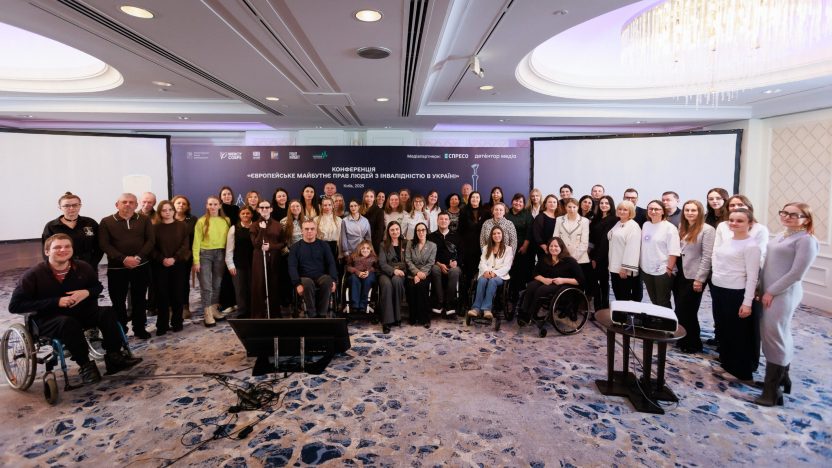
On 3 December 2025, a conference entitled ‘The European Future of the Rights of Persons with Disabilities in Ukraine’ was held in Kyiv. The event was organised by the organisation of persons with disabilities ‘Fight For Right’ and the Reanimation Package of Reforms Coalition with the support of international partner organisations. Representatives of the authorities, international partners and civil society discussed how to include the rights of persons with disabilities in all stages of European integration and the reconstruction of Ukraine.
At the opening of the event, Yulia Sachuk, chair of Fight For Right, said: “Despite the war, we, persons with disabilities, continue to fight for freedom and dignity. In 2021, Fight For Right, together with the RPR Coalition, held this conference for the first time so that people with disabilities could talk about what hurts them. Over the past four years, we have managed to achieve a lot and attract various partners. The fifth conference is a big event for each and every one of us and for the entire community.”
How can we make the inclusion of the rights of persons with disabilities in all stages of European integration more effective?
Olga Lymar, Executive Director of the RPR Coalition, noted: “EU accession is impossible without meeting the requirements for reforms on the rights of persons with disabilities. We often talk about this in the context of more popular reforms, such as judicial or anti-corruption reforms, but we try to emphasise that, in fact, accession to the European Union is first and foremost about the dignity and rights of our citizens.”
For her part, Lyudmila Fursova, advocacy manager at Fight For Right, is convinced that the state needs to involve organisations of people with disabilities at the stage of developing decisions, rather than at the stage of presenting them. “We can really provide more effective solutions because we have the knowledge and experience. We are carrying out deinstitutionalisation not for the European Union, or for the UN, or for anyone else, but for our people. We now have the opportunity to carry out deinstitutionalisation and release about 40,000 institutionalised people, restoring their right to independent living,” the expert noted.
Martin Mulek, Head of the Good Governance and Fundamental Rights Team at the European Commission’s Directorate-General for Enlargement and European Neighbourhood Policy (DG ENEST) of the European Commission, emphasised the importance of representing the Ukrainian community of persons with disabilities in European integration processes and added: “We are fully aware that Ukraine is in a very difficult situation due to Russia’s full-scale invasion. But we are optimistic about the work done in recent years and the progress made in addressing current issues, in particular the work to raise legislative standards in the context of EU integration.”


During the conference, participants also discussed the inclusion of veterans in community life, their rehabilitation, and social services after returning to civilian life.
Ruslan Prykhodko, Deputy Minister for Veterans Affairs of Ukraine, noted: “Our Constitution states that the key value for our state is the individual, their rights and freedoms. And our task is to make veteran-centredness, as we say, not just a nice presentation in the city of Kyiv, but an objective reality in communities. This is a huge and complex task. We are now laying down in legislation absolutely everything that would sever any ties with the remnants of the Soviet model.”
Tetyana Lomakina, Advisor to the President of Ukraine on Accessibility Issues, Kateryna Pryimak, veteran, head of the NGO ‘Women’s Veteran Movement’, Dmytro Lufer, consultant to the Ministry of Health, expert of the REHAB4U project, and Masy Nayem, veteran, lawyer, co-founder of the Principle Human Rights Centre for Military Personnel.
The event concluded with a press briefing entitled ‘5 victories and failures of 2025 in the field of human rights for persons with disabilities.’ More than 200 respondents noted that in 2025, the voices of persons with disabilities were heard louder. Organisations of persons with disabilities were increasingly involved in government working groups, humanitarian clusters, international events and discussions, which was one of the important victories of 2025. Thanks to the activity of the public sector, the interests of persons with disabilities began to be taken into account more in policy-making and implementation processes.


Яскравим підсумком Міжнародного дня людей з інвалідністю стала Акція видимості «Lights for Rights» на Майдані Незалежності, на яку з’їхалися учасники та учасниці з усієї України.


The conference was organised by Fight For Right and the Reanimation Package of Reforms Coalition in partnership with Mercy Corps, with financial support from the British Government and support from the International Renaissance Foundation and the Centre for Disaster Philanthropy.
Source: Reanimation Package of Reforms

