

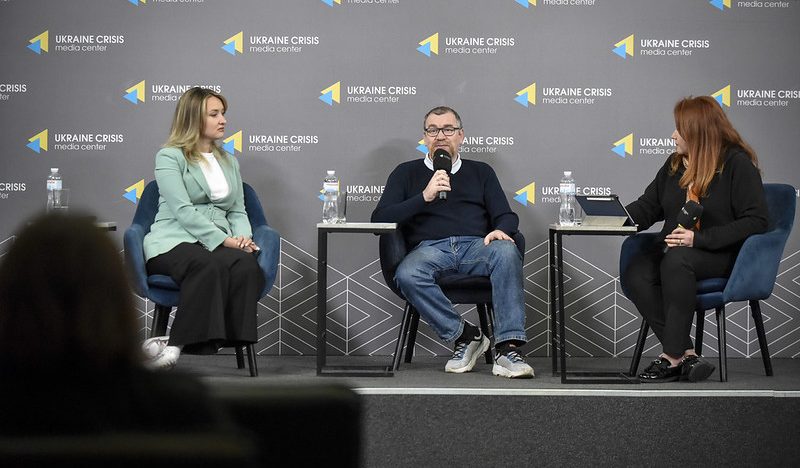
In 2016, only 5.8% of the waste generated in Ukraine was recycled, 2.7% was incinerated, 3.09% was sent to waste treatment facilities, and a very small percentage was composted. The rest—about 94%—ended up in landfills, of which there were officially 5,470 in the country. There are also about 30,000 unauthorized landfills. It is clear that with such a burden, the European Union will not be ready to accept Ukraine, and therefore government officials began developing waste management reforms long ago. The extent of progress made and the obstacles to implementing these changes were discussed during the panel discussion “Ukraine: European Code. Waste.” Regional journalists’ questions were answered by Marta Pankevych, an expert at the International Environmental Organization “Ecology. Law. People”; Olena Koltyk, head of the Ukraine Support Team (UST) and co-founder of the NGO “ReThink”; and Yevhen Bovsunovskyi, executive director of the National Ecological Center of Ukraine.
There Are Enough Laws
The moderator of the meeting, Tetyana Kolosova, head of the UCMC Press Center, expressed the view that the war is the factor that is currently the most decisive and is compounding our systemic problems. This includes all types of land pollution, the destruction of industrial facilities, toxic contamination, soil contamination, contamination of groundwater, water pollution, forest fires, and the destruction of entire ecosystems, as in the case of the Kakhovka Hydroelectric Power Plant. This entire sphere is the most critical for any country and affects the livelihoods of every household—from the individual to the community and the nation as a whole. But no environmental threats can alter the course chosen by the Ukrainian nation, and this only doubles the responsibility for carrying out reforms.
“The EU demands that we not only implement legislation, not only fulfill a single requirement, but completely overhaul our domestic policies—and that means our economy, our infrastructure, and, of course, the mindset of every single citizen. So, on the one hand, these are the European Union’s strictest demands on us, and on the other, the environment is the most important area for us. And here it is important to understand where Ukraine stands on its path to the European Union,” she asked the meeting participants.
Since the signing of the Association Agreement with the EU, Ukraine has committed to aligning its legislation governing waste management processes with European standards.
“In 2022, Ukraine adopted a new law on waste management, which took effect in July 2023. This is a framework law that essentially defines the key principles and foundations of what our future waste management system should look like. However, the scope of waste management is very broad and includes not only household waste but also all other types of industrial waste, hazardous waste, medical waste, and others. Therefore, to implement this law, 15 resolutions of the Cabinet of Ministers, 6 orders of the Ministry of Environmental Protection and Natural Resources, an order from the new Ministry of Economy, Environment, and Agriculture, and 5 orders from the Ministry of Community Development were adopted. “In other words, even the sheer volume of regulatory legislation illustrates just how extensive this reform is,” said Marta Pankevych.
However, time does not stand still. Over the past 10 years, new European Union directives have been adopted, to which we must also adapt our national legislation. This was the reason behind the adoption on April 1 of this year of the National Adaptation Program, which, in particular, provides for the adoption of at least 8 more laws by the end of December 2027. However, even this will not lead to a rapid transition from the current model to the European one.
“We must understand that this will take several years at best. And as for the situation we have now, we will actually see positive changes only in 10 years,” warned Marta Pankevych.
What’s Holding Things Back?
If there are no delays in establishing the legislative framework for the reform, why are the changes barely noticeable in practice? Experts point to several key issues that are hindering the European integration process in the field of waste management in Ukraine.
The first is the dissolution of the Ministry of Environmental Protection and Natural Resources. In July 2025, it was merged with the ministries of economy and agriculture, which weakened the environmental component.
The next problem is the rollback of reform implementation in areas where it has already been implemented. The government often likes to launch pilot projects. “With these pilot projects, we are undermining all our European integration processes and trying to find loopholes to circumvent the system that is being implemented,” added the expert from the NGO “Ecology. Law. Human.”
There are problems with hazardous waste management, as well as with the fact that legislation is being postponed until the end of martial law. There is a lack of state environmental oversight, including due to martial law. The State Inspectorate responds very poorly to inquiries, complaints, and inspections. In fact, the environmental sector—not just waste management—is currently somewhat unregulated and uncontrolled by anyone.
“I would like to point out the weakness of government policy as a whole. Thanks to the European Union, we have begun to adopt laws, and they are up to European standards. However, the regulations that could govern matters at the regional level are still lacking,” emphasized Yevhen Bovsunovskyi.
He sees the reason in the blurring of responsibility. It is not clearly defined anywhere. We must ask: who is actually responsible for implementing the reform, for the results we are supposed to achieve? Who will suffer if we fail to implement something or fail to meet our targets? Without accountability, there is no one to hold responsible for why things have not been done.
Regions Are Falling Behind
Within a year of the approval of our national waste management plan, each region was supposed to develop and approve its own plan. However, as of the end of March 2026, only nine regions had new regional waste management plans. These are Zaporizhzhia, Zakarpattia, Ivano-Frankivsk, Lviv, Kirovohrad, Kherson, Cherkasy, Chernihiv, and Poltava regions. Rivne, Odesa, and Volyn regions are operating based on the old national plan. All other regions do not have their own regional waste management plans, which delays, among other things, the development of local waste management plans.
And this is from a bureaucratic perspective. In terms of innovations and the implementation of successful practices in the field of waste management, the situation varies across regions.
“In practice, the best organizational model I’ve seen is in Khmelnytskyi,” noted Olena Koltyk.
Marta Pankevych spoke about the mechanical-biological treatment plant in Lviv: “It is currently under construction and is estimated to cost 48 million euros. Yes, it’s expensive; waste management requires significant financial investment. But if it’s economically viable for businesses, such investors will come to Ukraine and expand our technological infrastructure for managing waste from various operations.”
And what about waste resulting from the enemy’s destruction of structures? This question came from Snigurivka in the Mykolaiv region, which was under Russian occupation for some time.
Olena Kolyk explained that legally, the local government is responsible for this demolition, but everyone understands that it lacks the funds for this work.
“The proper approach is to demand that work related to debris from the destruction be included in the regional plan, along with funding for these efforts. And that it’s not just you, as a community, who are seeking funding for the cleanup—the regional administration should also get involved, share this responsibility with you, and help you secure funding for the cleanup. This could come from your local budget, the regional administration’s budget, or state subsidies, if they become available. I can say one thing: many of your local issues aren’t being communicated to higher authorities. You need to raise your needs through any available channels, because not everything reaches those higher levels, even at the immediate level,” replied the head of the Ukraine Support Team.
It’s Not Just About Money
Waste management in Ukraine today is an extremely costly endeavor, and a lack of funding remains the main problem. Neither local communities nor the national government allocate sufficient funds for waste management. But when we talk about waste and environmental issues, it’s not just about the economy—it’s a matter of people’s lives and health.
“The ‘polluter pays’ principle has long been in place in the European Union, and it is manufacturers and consumers who finance the system through tariffs. For Ukraine, this means that a key step must be the introduction of producer responsibility in the packaging sector, since a significant portion of household waste consists of packaging. This will be the cornerstone of reforming the system and ensuring its financial sustainability,” Olena Kolyk is convinced.
Planning, in her view, is a crucial step. Today, regional waste management plans often look like formal documents that lack a real strategy. Without quality plans, we will not be able to attract investors and build new plants. Therefore, the public and journalists must actively participate in their discussion, submit comments, and demand real solutions.
Construction and demolition waste poses a separate challenge. In Europe, this is the largest waste stream, and there is a requirement to recycle at least 70% of such materials. The Czech Republic has already reached a rate of 93%, using waste to fill quarries or produce new construction materials. Ukraine needs to follow suit, launch pilot projects, and adopt European practices.
An equally important issue is hazardous waste, such as batteries and accumulators. Their disposal is only possible through licensed companies. Previously, batteries were collected at supermarkets and sent for recycling to Romania, but the problem is that small volumes are unattractive to licensees. A solution could be the creation of local waste management centers that collect batches and collaborate with licensed enterprises. An example is Khmelnytskyi, where such a center has already been established. Kyiv also plans to do this in accordance with its plan.
In short, Ukraine needs comprehensive waste management reform: funding based on the “polluter pays” principle, high-quality regional plans, the adoption of European practices in the field of construction waste, and the establishment of hazardous waste treatment facilities. Only in this way can we build an effective system that protects people’s health and the environment. And it is precisely this kind of system that the European Union will gladly welcome us with.
The event took place as part of the project “European Integration: Making the Complex Simple,” with financial support from the International Renaissance Foundation.
Source: Public Space

