

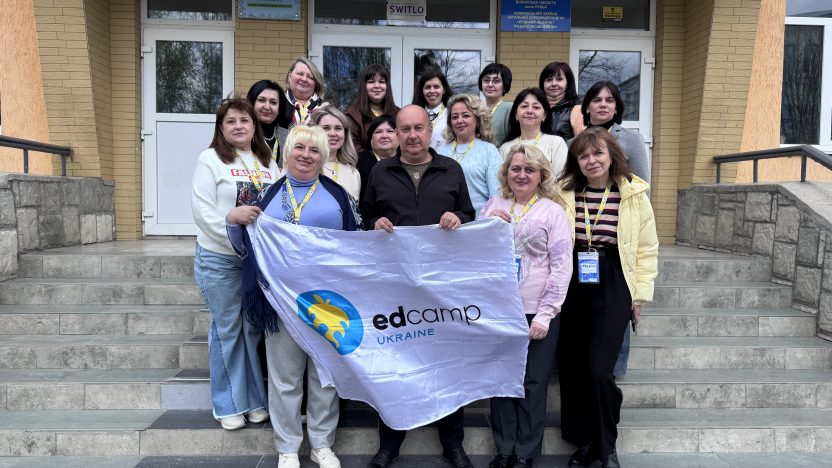
In December 2025, the NGO EdCamp Ukraine, an institutional grantee of The Impulse Project, developed a model, methodology, and toolkit for the public accreditation of general secondary education institutions and obtained official authorization to conduct it. This created the first precedent in Ukraine where a civil society organization received the right to independently assess the quality of education at the national level. In spring 2026, EdCamp carried out the first accreditation of two educational institutions.
“Today, education is about openness to new ideas, readiness for development, and responsibility for change. And we are ready to take on this responsibility,” says Olena Masalitina, Vice Chair of the Board of EdCamp Ukraine.
As part of its institutional development within The Impulse Project, EdCamp Ukraine advocates for changes in educational policy and their implementation. Public accreditation has become one of the tools that allows the organization to pilot new approaches and recommendations directly within educational institutions. Institutional support enabled EdCamp Ukraine to advocate for these changes and implement a complex, comprehensive process, creating conditions for systematic work rather than isolated initiatives.

“Today, public accreditation in two educational institutions is only the beginning. This became possible because strengthening the institutional capacity of civil society organizations, particularly within the framework of The Impulse Project, allows organizations both to respond to challenges within the education system and to shape new practices and policies that work in real schools and can be scaled nationwide,” representatives of the organization note.
Public accreditation of educational institutions in Ukraine has a clear legal foundation established by the Law of Ukraine “On Education” in 2017. Article 49 defines it as an independent evaluation of the quality of educational activities conducted by public associations.
After receiving the relevant authorization from the State Service for Education Quality, EdCamp Ukraine formed and trained an expert team that included 28 highly qualified teachers and school leaders from general secondary education institutions.
Between April 13 and May 13, 2026, the first public accreditation in Ukraine took place at these institutions. The pioneers were Lutsk Lyceum No. 1 and Gymnasium No. 5 of the Zviahel City Council.

“What lies at the core of this evaluation? First and foremost, the principle of ‘peer-to-peer.’ This means the evaluation is conducted by practitioners who deeply understand the educational context. The next principle is partnership. It implies trust, support, and shared responsibility. And, of course, open dialogue — professional, evidence-based, and development-oriented through cooperation,” says Leonid Myronenko, coordinator of the “Public Accreditation” project.
This new format for Ukraine serves as an alternative to the institutional audit conducted by a state institution.
Public accreditation has several distinctive features:
- It is voluntary and initiated by the educational institution itself. This demonstrates the internal maturity of the teaching staff and their readiness for development and change.
- The accreditation procedure lasts five days regardless of the size of the institution or the number of students. The public accreditation certificate remains valid for five years.
- The focus is on educational approaches that are critically important today and in the unpredictable future in which our children will live, namely: social-emotional learning, inclusivity, and a non-discriminatory environment. Their cross-cutting integration into the state-defined educational framework is a key feature of the Model developed by the NGO EdCamp Ukraine.
- Beyond conclusions and recommendations, one of the key outcomes is identifying potential areas for growth.
- During the post-accreditation period, and upon the request of the educational institution, a roadmap is jointly developed alongside consultation support and opportunities for professional development for the teaching staff.
“My main motivation for participating in this pilot was that I myself have led an NGO for 20 years. That is why cooperation with civil society, international partners, and projects like this inspires enormous trust in me. We are able to move faster and have more space for creativity,” summarizes Larysa Kapchynska, Principal of Gymnasium No. 5 of the Zviahel City Council.
This material was prepared by EdCamp Ukraine within The Impulse Project, implemented by the International Renaissance Foundation and East Europe Foundation with funding from Norway (Norad) and Sweden (Sida). The content of this material does not necessarily reflect the position of the International Renaissance Foundation, East Europe Foundation, the Government of Norway, or the Government of Sweden.

