

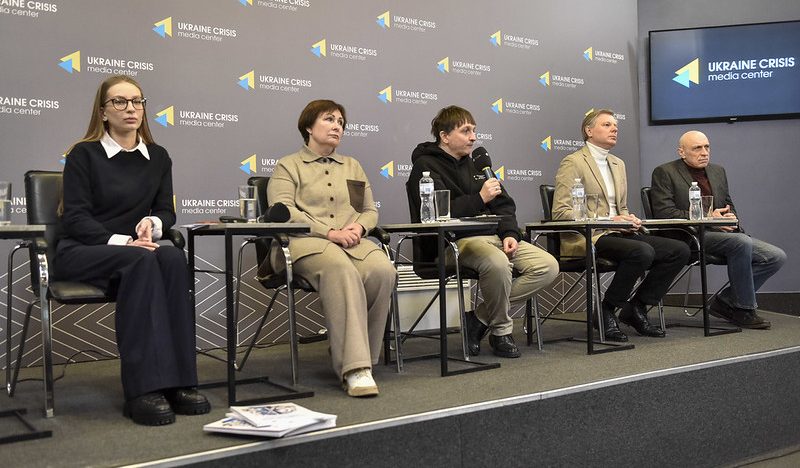
Every day since the start of the full-scale invasion, Ukrainian law enforcement agencies have recorded about 140 new war crimes committed by the Russian army. Over three and a half years of war, more than 185,000 have been registered. However, only 446 cases have gone to court, and verdicts have been handed down in 156 cases. These data are contained in a study by the Ukrainian Helsinki Human Rights Union, which was presented at the Ukraine Crisis Media Center.
What factors are slowing down the process? First, human rights activists note that the system is effectively on the brink of collapse. Almost half of the law enforcement officers surveyed noted that the staffing of the units is insufficient. The vast majority of investigators and almost half of prosecutors have less than three years of experience in investigating war crimes. At the same time, the workload on these specialists is enormous.
67.2% of prosecutors are conducting procedural supervision in more than 100 war crimes cases simultaneously. For comparison, only 27.4% of investigators have more than 100 cases under their supervision. This disproportion inevitably affects the quality of procedural supervision and creates risks for compliance with procedural standards.
The problems are not limited to personnel. A significant number of investigators and prosecutors face a lack of technical resources: no vehicles, including armored ones, no individual workstations, no office equipment, and no personal protective equipment. This creates not only organizational inconveniences, but also a threat to the life and health of law enforcement officers.
According to Article 216 of the Criminal Procedure Code, pre-trial investigations under Article 438 should be conducted by the Security Service of Ukraine. However, in practice, one-third of cases are investigated by the National Police, which is a separate problem.
Particular difficulties arise with the investigation of cases in absentia—in absentia, without the presence of suspects. After all, the vast majority of Russian war criminals are located in the occupied territories or in Russia.
Martial law complicates the traditional notification of suspects, forcing law enforcement agencies to use alternative methods in addition to those provided for by procedural law — through social networks and messengers, which are not officially provided for by Article 135 of the Criminal Procedure Code of Ukraine.

Civil society organizations play an important role in documenting war crimes, but the lack of clear legal norms regarding the admissibility of evidence collected by non-governmental organizations creates risks of such evidence being challenged in court and may reduce the effectiveness of its use.
Based on the results of the study, experts from the Ukrainian Helsinki Union developed a series of recommendations for the Verkhovna Rada, the Cabinet of Ministers, the Office of the Prosecutor General, and the Ministry of Internal Affairs.
First of all, it is necessary to increase the number of specialists in specialized units of law enforcement agencies that investigate war crimes. They should be provided with armored vehicles, modern equipment, and personal protective equipment.
It is necessary to regulate the issue of jurisdiction by amending the Criminal Procedure Code and improving the procedure for notifications in cases in absentia. Legislate criteria for particularly complex criminal proceedings.
At the same time, it is important to ensure an even distribution of the workload, establish systematic interaction between investigators, prosecutors, and defense attorneys, and organize regular training in international humanitarian law.
Executive Director of the Ukrainian Helsinki Human Rights Union Oleksandr Pavlichenko: “We are working together with our law enforcement agencies to improve the situation with the investigation, because this is a huge array of crimes. There are more than 208,000 war crimes, and unfortunately, this number is still growing. We need to think about how not just statistics, but the implementation of these statistics will help bring real war criminals to justice.”
Roman Romanov, Program Director of the International Renaissance Foundation: “From the very beginning, Ukraine has stated its intention to investigate everything that happens within Ukrainian jurisdiction. On the one hand, this was a courageous step, but on the other hand, it is clear that such an intention must be based on institutional capacity, on a sufficiently sophisticated legislative system that allows this intention to be effectively implemented. Therefore, I believe that from the perspective of non-governmental human rights organizations, it is very important to take stock from time to time and see how things are going. We all support this intention to investigate as thoroughly as possible, but we need to understand what obstacles there are and how effectively this work is being done.
Source: UKMC

