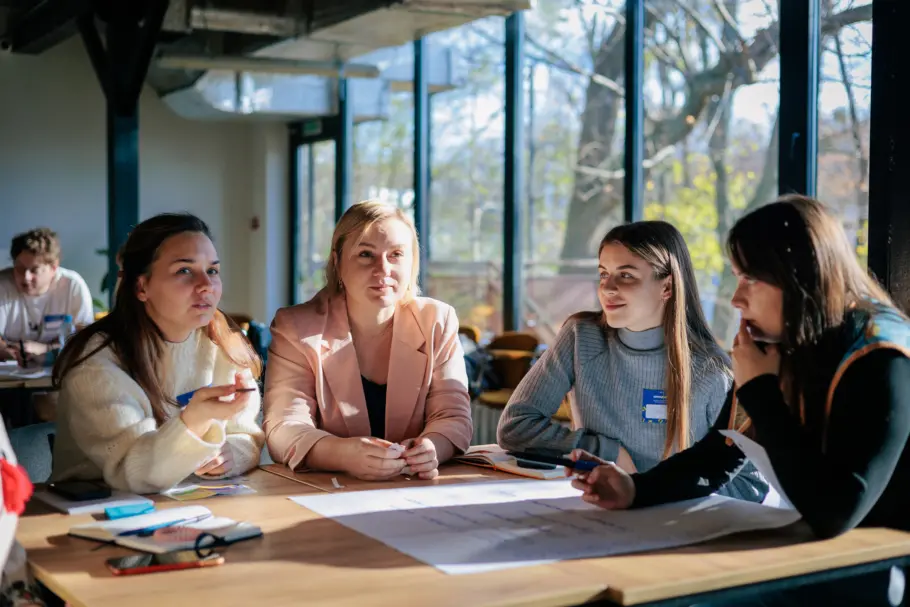
A Small Victory: How Children from Kherson and Avignon Created a Book Together
“Kabitsa in the Kherson Courtyard” is the title of a bilingual book that is the result of a creative collaboration between two groups of children from Kherson, Ukraine, and Avignon, France.
The idea for the book came from Tetyana Sushkova, a librarian with the Kherson Centralized Library System. Most of the children who visit the library did not leave Kherson during the occupation. Each of them has their own, sometimes very difficult, memories of what they went through, and these memories deserve to become part of our shared historical memory of that period.
“I shared my idea—not only to write a book with children from Kherson but also to involve their peers from France in this project—with our good friend, literary scholar Tetiana Ogarkova, who, while on work visits to France, consistently sent updates and warm words of support to our readers,” , she said at the book’s presentation at the Ukraine Crisis Media Center.
The young people from Kherson were asked to write a story based on their own experiences of life under occupation, while their French peers were asked to write a continuation and conclusion to that story. This format became an example of true co-creation, combining the personal memories of Ukrainian children with the incredible empathy, compassion, and creative vision of the children from France.
Children’s author Ivan Andrusyak played an important role in the literary editing of the text. Every week, he joined the meetings via video conference, analyzed the excerpts written by the children, and helped them find creative approaches and develop literary characters.
Work on the book began in the summer of 2025. About 15 young readers from the children’s library, aged 7 to 17, took part in the project.
“The children told their poignant stories and shared memories of daily life under occupation. I was struck by the fact that each of them recalled the incredible mutual support among the city’s residents. That, despite everything, there were neighbors who helped elderly grandmothers stock up on water or get medicine from somewhere. This inspired me to suggest that they not focus on the tragedy of the occupation, but rather show that Kherson is truly a city of strong, unbroken people,” Tetyana Sushkova recalled.
In the spring of 2026, literary consultant Anne Udi visited Kherson as part of a PEN Club delegation. After seeing the city, its realities, and its residents, and talking with young authors, she admitted that her life was now divided into “before” and “after.”
Upon returning to Avignon, she told the children what was happening in Kherson, showed them videos and photos, and very soon after, the French creative group completed work on their section.
“At first, we didn’t know how to start this story. The problem was finding the entry point into this book. It was a real challenge figuring out how to get into this book. I walked around the neighborhood where the characters live a lot, talked to children, and observed how, for example, a cat behaves. We have cats too, but ours are house cats—they aren’t strays; they’re different—they have owners. But there I saw a lot of stray animals. “Yes, the stories of these animals also find their place in our book,” noted Anne Udi.
This book required two translators. The section written by Ukrainian children had to be translated into French. This work was done by Alexi Odone.
“I was moved when I heard the children from Kherson and also the children from Avignon. Having such a valuable project today—such a connection between children who, I’m sure, would be friends in real life—is very important to me,” he said.
Iryna Slavinska, on the other hand, translated the French portion of the book. As someone who remained in Kyiv during the most difficult times, the experiences of the children from Kherson resonated deeply with her.
“The way this story is conveyed through children’s narratives, through a children’s story—to me, it’s something truly horrifying. Because your voice—which at first hesitates, then speaks out, and finally asserts itself—was, for me, the key to understanding the meaning of this book,” she admitted, addressing the young authors.
Writers Anna and Lauren Sham-Massar also contributed to the book’s text.
“This mix of children in a children’s story—the narrative of children describing, for example, the construction of a little hut in the yard, the way children build things—but it takes place during a war with the goal of survival, and that really moved me. And the way the children worked together, the poetic way they did it, conveying their feelings and desires—‘I wish, I wish’—we see this as a refrain, we hope—that’s what provides a lot of additional insight into what’s happening. We were there on location with Ann, and then we helped describe the details that might not have been clear from the start. For example, “two hundred,” “three hundred”—what does that mean? Or if someone was taken “to the basement.” The French don’t understand what that refers to—that a person might be subjected to torture. And that’s not something you can explain with annotations. We needed to clarify these things in a non-didactic way and draw parallels between these two worlds,” recalled Anna Sham-Massar.
At the end of the presentation, the event’s moderator, Tetiana Ogarkova, called the book *The Squirrel in the Kherson Yard* a small victory for everyone who worked on it.
“It is our victory over that fear, over the uncertainty stemming from the absence of a future, and proof that we have each other, that we can work together, that we can create something great together. Every illustration in this book, every revision, everything we did for this book—it’s a victory for each of us over the circumstances, over this situation we find ourselves in,” emphasized Tetyana Ogarkova.
This book was produced with the support of the Ukrainian Crisis Media Center, the Ukrainian Center of International PEN (PEN Ukraine), and the International Renaissance Foundation.
Source: UCMC