Resilience Begins with Responsibility: Key Messages from Volodymyr Yermolenko’s Speech at the 2026 Resilience Conference
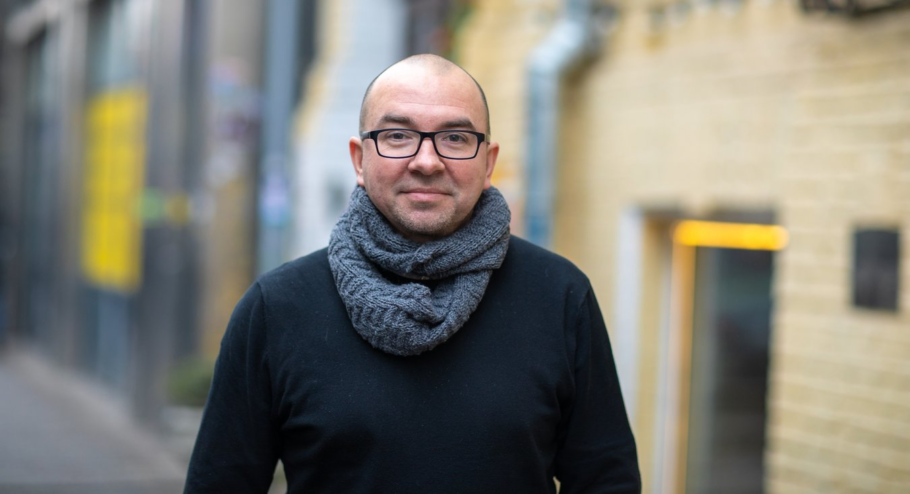
How can Ukrainian society maintain resilience during the war? Why should responsibility not be placed solely on the state? And how can Ukrainians ensure that their strength does not become a vulnerability? These were among the questions explored by Volodymyr Yermolenko, philosopher, writer, President of PEN Ukraine and a member of the Board of the International Renaissance Foundation, during the 2026 Resilience Conference.
“I would like to talk to you about three things,” Volodymyr Yermolenko said as he began reflecting on Ukrainian civil society, its strengths and weaknesses, its relationship with the state, and the responsibility each of us bears for what happens around us.
Society Must Shape the State
According to Volodymyr Yermolenko, one of the key differences between Ukrainian and Russian political cultures lies in the relationship between society and the state.
“In Ukraine and in Europe, villages and cities build the state. In Russia, the state builds the cities. Everything there happens from the top down. That is why everything depends on the tsar, on the emperor. Here, things happen from the bottom up.”
Yermolenko argues that Ukrainian civil society plays a significant role in shaping the state. This relationship can be seen, for example, at the local level, through the development of communities, cultural spaces, libraries, book festivals and other initiatives. Such processes demonstrate a demand for culture, education and self-organization that emerges from the grassroots.
“In our culture, I keep saying: read Ukrainian classics, because they contain not so much answers as the right questions. Let me remind you of two works you know very well.
The first is The Black Council by Panteleimon Kulish, which shows us this element of Ukrainian anarchism that can lead us into trouble. The second is The Kaidash Family, which is actually a very political work. You could set it at the court of some king, and you would find exactly the same problems there. But instead, it is set within a rural family.
In fact, family and community relations do not change depending on where they are set. And this inability to deal with our conflicts, to resolve them, combined with the desire to push everything to the limit and turn conflicts into explosions — it seems to me that our classics give us these diagnoses. So we need to understand where our weak points are and avoid them.
And what I wanted to say — and this is where I will finish — is that when we return to the question of how we can preserve this resilience, it seems to me that resilience, forgive me for the banality, is directly connected to responsibility.”
At the same time, Yermolenko argues that Ukraine is still having to overcome the influence of a post-Soviet political culture in which the state is perceived as the force that makes most decisions, while society is seen as a much weaker participant in political processes.
“And Now, the Risks”
“And now, the risks. The risk is that pluralistic democracy is not an answer to every question. As is often the case in life, what is your strength can turn into your weakness. And vice versa,” Yermolenko continues.
“In Ukraine, our weakness turns into strength. Our distrust of state institutions creates this hyper-responsibility within society. And that is our strength. But it can become a weakness. It becomes a weakness when we start fragmenting. When we start waging an internal war. When we start blaming those who are working in the same field as us. Not criticizing them, but actually blaming them, turning against them, and so on.
Unfortunately, I see a lot of these tendencies — in the cultural sector, perhaps in business as well, and elsewhere. And it seems to me that we need to avoid this.”
Yermolenko stresses that it is important not only to recognize the strength of civil society, but also to understand its vulnerabilities and learn how to work through conflicts without allowing internal divisions to undermine our collective capacity to act.
Resilience Is About Responsibility
Another important theme of the speech was resilience.
Yermolenko said:
“It seems to me that resilience, forgive me for the banality, is directly connected to responsibility. Everyone in our country talks about responsibility. Few people demonstrate it.
Actually, that’s not quite right — I phrased it incorrectly. On the contrary, there are many people who demonstrate responsibility, both in the military and in the volunteer movement. There are many people who give more than they take. And we need to recognize that too.
But there are also many people who still avoid responsibility. The problem is that we struggle to think about responsibility in broader terms.
‘These are my six hectares of land — I am responsible for them.’ We need to think in terms of expanding responsibility. Because if we take responsibility only for our small piece, that is not enough. There are too few of us right now.
Each of us should think, even though it is very difficult in these times, with so many risks, stress and dangers, about how we might expand our sphere of responsibility, even by a millimeter. How capable are we of doing this — as a society, as individual citizens, as individual communities? A great deal depends on it.”
Yermolenko introduces the concepts of “cascading agency” and “cascading responsibility”, encouraging people to recognize that many decisions shaping our lives depend on us and on the choices we make here and now, at our own level.
He says:
“I think this tendency to shift responsibility onto someone else — the central government, external forces, the enemy, and so on — is a kind of psychological trap. It draws us into a discourse about who is to blame.”
Filling Your Cup
In concluding his remarks, Yermolenko turned to the philosophy of Hryhorii Skovoroda and his famous image of the fountain. He also argued that Ukrainians need a discourse focused on what can be changed under the current circumstances: how we can improve our own situation, as well as that of the people and communities around us.
“And here I return to our classic, Skovoroda. Let us think about his key idea, this famous image of the fountain that appears on our currency — ‘unequal equality’. What does it mean?
It means that the question is not how you compare yourself with someone else. We should not constantly compare ourselves with others. What matters is recognizing what you are capable of doing and fully realizing that potential.
The main idea behind the fountain is how full you are, how full your cup is. You may have a small cup — a small community — but you fill it completely. You may have a large cup, but you may not fill it completely. You may have more water than someone with a smaller cup, but you simply did not do everything you could to fill yours.
And so, in quantitative terms, you may have more resources or opportunities than someone smaller. But you may realize your potential, your purpose, less fully than someone with a smaller cup who has filled theirs more completely.
I think this is very important. Resilience depends on understanding that we are not competitors with one another. Of course, sometimes we can be competitors. But what matters is how fully we can fill the history, culture and community that have been entrusted to us — so fully that it begins to spill over the edge.”