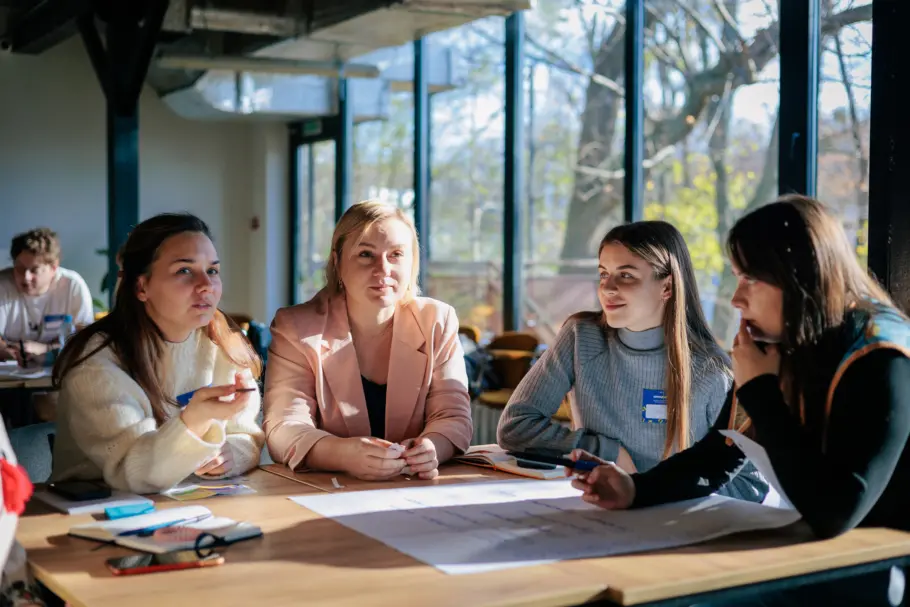
A Shared Vision of a New Home: How the People of Bakhmut Are Shaping the Demand for Housing — Video Report
Today, more than 70,000 residents of the Bakhmut community are living in different cities across Ukraine and abroad. Most of them have no opportunity to return home, while housing remains the community’s most urgent and painful issue.
The project A Shared Vision of a New Home: Pre-Project Discussions on a Residential Quarter for IDPs from Bakhmut is aimed at finding long-term housing solutions for internally displaced people from Bakhmut. The initiative is being implemented through a partnership between the Bakhmut City Military Administration, the NGOs “Bakhmut Fortress” and “Anti-Crisis Media Center. Donetsk Region,” and the urban coalition “Ro3kvit” within The Impulse Project, implemented by the International Renaissance Foundation and East Europe Foundation with funding from Norway (Norad) and Sweden (Sida). Watch more in the video report.
As part of the project, the team conducted a pre-project study intended to form the technical brief for the future design of a residential quarter. A key principle of the initiative was balancing the needs of the Bakhmut community, the host community, and the environmental characteristics of the potential construction site.
One of the key stages of the project was a survey among displaced residents of Bakhmut, in which more than 700 people participated. The results helped identify the community’s actual needs, including the need for affordable and inclusive housing adapted for people with disabilities and older residents, as well as the importance of preserving the community’s identity within a new living environment.
In addition, the team analyzed Ukraine’s current housing policy, legislative mechanisms, and the experiences of other communities attempting to implement similar housing projects. This work made it possible to formulate recommendations for future architects, planners, and partners, while also identifying the risks and limitations faced by communities displaced from temporarily occupied territories.
Throughout the implementation of the project, the team also focused on public communication and outreach. They prepared analytical and journalistic materials, videos, and publications dedicated both to the project itself and to the broader issue of housing for internally displaced people. These materials focused on existing housing mechanisms, the challenges and limitations faced by displaced communities, and possible approaches to developing long-term housing policies during wartime.
The research findings are currently being prepared for public presentation. The next stage will involve searching for partners and funding to implement the housing construction project. There is still a long road ahead, but systematic work focused on the needs of the community can bring closer the day when the people of Bakhmut will once again have homes of their own.
This material was prepared within The Impulse Project, implemented by the International Renaissance Foundation and East Europe Foundation with funding from Norway (Norad) and Sweden (Sida). The content of this material does not necessarily reflect the position of the International Renaissance Foundation, East Europe Foundation, the Government of Norway, or the Government of Sweden.