
Sixty Years of Ties That No One Counted: What Ukraine Has in Africa and Why It Matters
Among the graduates of Ukrainian higher education institutions are former and current ministers, ambassadors, and judges from dozens of African countries. The study “Ukraine and Africa: A Shared History and Development for the Future” (conducted by the NGO “Platform for the Development of Youth Initiatives” and the Youth Council under the Ministry of Foreign Affairs of Ukraine, with support from the International Renaissance Foundation) was the first to systematically assess the scope of these ties and demonstrate why Ukraine has yet to utilize a resource it has been building for over half a century.
When people talk about Ukraine’s policy toward Africa, they usually mention the opening of new embassies, diplomatic tours, or the fight for support for Ukrainian resolutions at the UN. But one of Ukraine’s most valuable resources on the continent emerged much earlier. It does not need to be created or funded from scratch—it already exists. For over sixty years, Ukrainian universities have educated future doctors, engineers, diplomats, and civil servants from dozens of African countries. The only problem is that Ukraine hardly makes use of this human capital.
Starting in the 1960s, Ukrainian higher education institutions became part of the Soviet system for training personnel for young African states. During the 1971–1972 academic year, one in five international students in the Ukrainian SSR was a citizen of an African country. At that time, 1,253 students from dozens of countries across the continent were studying at Ukrainian institutions of higher education. Representatives from more than 35 African countries studied at Kyiv University, the Kharkiv Medical Institute, the Odesa Institute of Marine Engineers, and dozens of other institutions. They were trained to become doctors, engineers, lawyers, and public administration specialists.
Among the graduates of the Educational and Scientific Institute of International Relations at Taras Shevchenko National University of Kyiv alone, there are dozens of documented cases of individuals who later became foreign ministers, ambassadors, supreme court justices, heads of state-owned corporations, and other high-ranking officials in Kenya, Chad, Angola, Burkina Faso, Tanzania, and other countries. And this is just one Ukrainian university. No one knows today how many similar stories are preserved in the archives of other educational institutions.
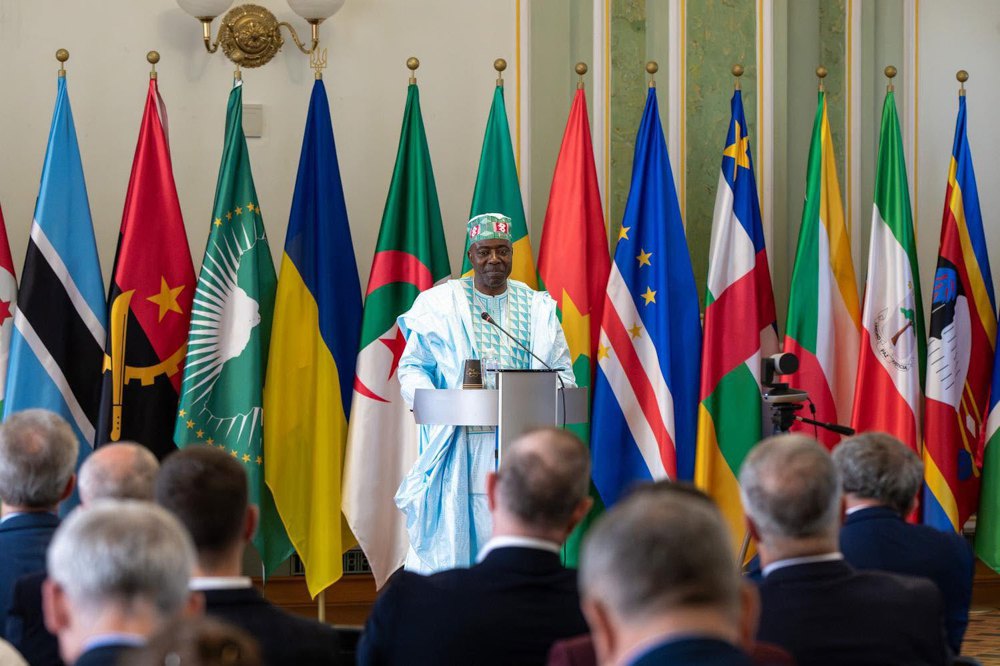
Photo: Facebook/Ksenia Semenova
Diallo Issa Sadio, chairman of the African Council in Ukraine. He graduated from the National Aviation University in Kyiv.
But the main problem is that a significant portion of graduates from the Soviet era do not associate their education with independent Ukraine. They studied in Russian, maintained connections through Soviet or Russian-speaking networks, and often view their student experience as part of the history of the USSR as a whole. For them, the Russian language remains the primary cultural marker of their historical connection to the country where they studied. Russia actively exploits this, systematically positioning itself as the sole heir to the Soviet presence in Africa. While Ukraine has done almost nothing to engage with this educational legacy, Moscow is turning it into a powerful foreign policy tool.
In independent Ukraine, ties with Africa have developed on a market-based foundation. Ukraine remained competitive in the international education market thanks to affordable tuition, the development of English-language programs, and a positive reputation built over the years by graduates of African descent themselves. On the eve of the full-scale invasion, 26,259 students from African countries were studying at Ukrainian universities—the highest number in the history of independent Ukraine.
The full-scale war drastically changed the situation. By 2026, the number of African students had dropped by more than 94 percent, totaling 1,567. At the same time, even amid the war, Ukrainian universities enroll about 380 new students from African countries each year, and students from more than forty countries continue their studies in Ukraine. This means that, despite unprecedented challenges, Ukrainian education has not lost its reputation. Instead, it has preserved the minimal foundation and potential upon which cooperation can be rebuilt once the war ends.
The problem lies in the fact that this potential remains largely uninstitutionalized. Ukraine still lacks a unified alumni registry. Data remains scattered among individual universities, and responsibility for alumni relations is not assigned to any single government institution. Between 65 and 90 percent of international applicants are recruited to Ukrainian universities through private agents, so the institutions themselves often do not even maintain direct contact with their graduates. Added to this is another structural problem: nearly three-quarters of the current African student body comes from just Morocco and Nigeria, and two-thirds of the students are enrolled in three medical programs. This model works, but it is narrow and vulnerable to any crises.

Photo: Maksym Subkh / Facebook
Opening of the Ukrainian Embassy in the Democratic Republic of the Congo. April 12, 2024
Africa has long ceased to be on the periphery of world politics. The adoption in 2022 of the Strategy for Relations with African States by the Ukrainian Ministry of Foreign Affairs and the opening of seven embassies only confirmed the strategic importance of Africa for Ukrainian foreign policy. However, no diplomatic strategy will be effective unless it builds on existing human connections and fosters the creation of new ones. In this context, it is precisely the graduates of Ukrainian universities who can become the network of trust upon which Ukraine’s long-term cooperation with African states will be built.
In order to transform existing human capital into a real instrument of cooperation, Ukraine must create a unified registry of graduates and place the coordination of these efforts under the authority of the Ministry of Foreign Affairs of Ukraine; document the testimonies of the 1960s–1980s generation while its representatives are still able to provide them; encourage the transition to English- and Ukrainian-language programs while maximizing the Ukrainian-language component in the curriculum for students of African descent; institutionalize alumni engagement at the national and university levels; and transform archival lists into active alumni networks where graduates become ambassadors for Ukrainian education.
Unlike many African countries, Ukraine does not need to build human capital from scratch. It already exists. For over sixty years, Ukrainian universities have been building a network of people who today work in government institutions, diplomacy, medicine, education, and business in dozens of African countries—or are on their way to doing so. Most countries spend decades and significant resources to build such networks of influence. Ukraine, however, already has them as a result of its own history of educational cooperation. The only question is whether we will finally be able to transform university archives into a tool of modern diplomacy, or whether we will continue to lose touch with our heritage.
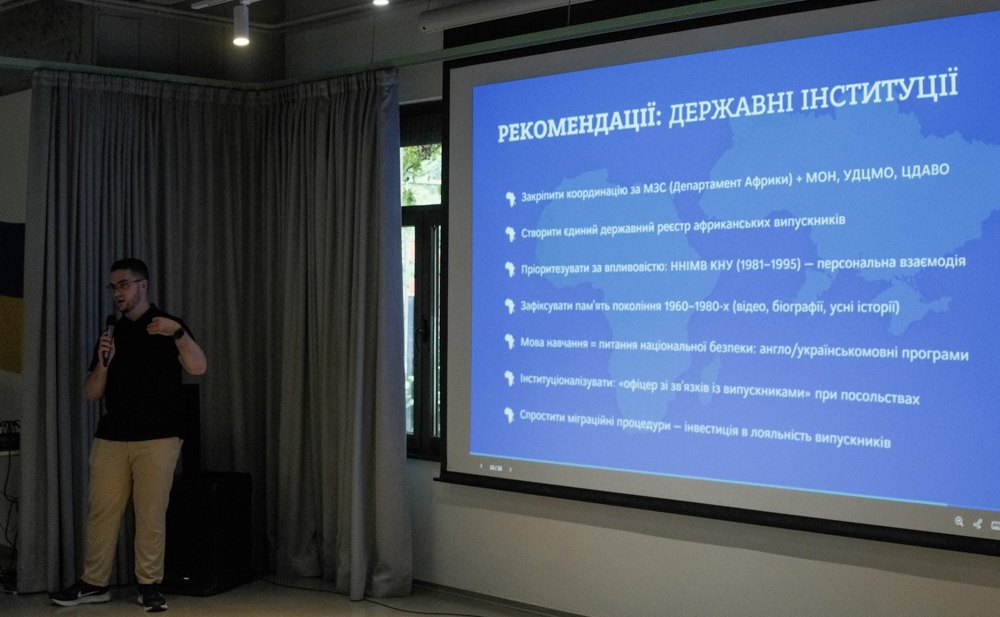
Photo: Youth Council under the Ministry of Foreign Affairs of Ukraine
At the presentation of the study.
Read the full study at the following link: https://beacons.ai/youthcouncilmfa
The study “Ukraine and Africa: A Shared History and Development for the Future” was prepared by the NGO “Platform for the Development of Youth Initiatives” and the Youth Council under the Ministry of Foreign Affairs of Ukraine as part of a project supported by the International Renaissance Foundation. This material represents the authors’ views and does not necessarily reflect the position of the International Renaissance Foundation.
Source: Livy Bereg