Ukrainian PEN’s Literary Volunteer Trips: How Artists and Journalists Support Libraries in De-occupied and Frontline Communities
Support for Libraries: Is It Timely?
Since the start of the full-scale invasion, the needs of Ukrainian communities have changed significantly. Rebuilding homes, restoring infrastructure, and supporting the military and their families are the main priorities that have been the focus of the entire nation for four years now.
And it is quite obvious that other issues (for example, in the fields of education or culture) have taken a back seat. But can a country function when there is no support for schools, libraries, arts spaces, and youth centers? Ukrainian PEN sought the answer to this question in 2022. And it found it!
Since June 2022, Ukrainian PEN has been organizing literary volunteer trips to de-occupied and frontline territories in Ukraine. Ukrainian and international foundations, civil society organizations, publishers, and concerned individuals who send books are helping with this effort.
The primary goal of these trips is to deliver books in Ukrainian and foreign languages to libraries in frontline and de-occupied territories. At the same time, during these visits to communities, writers and journalists provide volunteer assistance, document Russia’s crimes against Ukrainian culture, and hold meetings with local residents.
Ukrainian PEN also provides support to damaged or destroyed libraries as part of the “Unbreakable Libraries” campaign—an initiative through which libraries in 17 regions of Ukraine have already received over 100,000 books in Ukrainian and English.

“Each of these trips is unforgettable—mainly because there is something to learn from every one of them. Sometimes it’s a lesson in humility, when you see how much effort it takes to carve out a narrow path for the flow of new and fresh ideas that smaller communities so desperately need to keep moving forward. But mostly—it’s about self-belief and the knowledge that you’re doing the right thing, that in our vast country there’s always a place, everywhere, where you’re welcome and where you can contribute to changes that may not be immediately visible but are truly effective,” noted translator and coordinator of literary volunteer trips Anna Vovchenko.
As of March 1, 2026, Ukrainian PEN has organized over 40 literary volunteer trips to all liberated and frontline regions of Ukraine: to the Kharkiv, Chernihiv, Odesa, Mykolaiv, Kherson, Sumy, Dnipro, Donetsk, Zaporizhzhia, and Kyiv regions, among others. Ukrainian and foreign writers and journalists participate in each trip.
The 41st literary volunteer trip
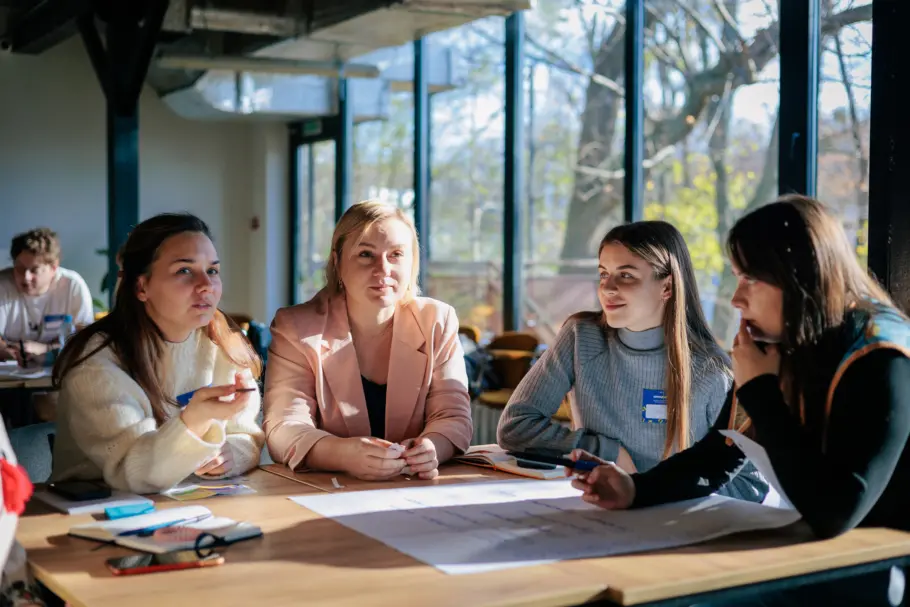
Ukrainian PEN held its 41st literary volunteer trip in the Kyiv region. On February 22–24, writers Halyna Malyk, Maryna Hrymych, Khrystyna Morozova, and Olesia Mamchych, as well as psychologist and researcher Ashley Humphrey from Monash University in Melbourne (Australia), a fellow at INDEX: Institute for Documentation and Engagement, set out on a journey through the region.
The itinerary took us through Sofiivska Borshchahivka, Bila Tserkva, Fastiv, Kovalevka, and Ukrainka.
“The morning of the first day began in Sofiivska Borshchahivka. I saw for the first time a library set up in a sports center next to a soccer field. Next, we had a meeting at the Bila Tserkva Youth Center. When I heard that people were traveling there from neighboring towns, I felt a little ashamed that I sometimes don’t want to leave the left bank of Kyiv.
The next day, an event for children was scheduled at the St. Martin de Porres Charitable Foundation School in Fastiv. I’m skeptical about combining religion and education, but this school is pure love. The children here are genuine, cheerful, and happy,” noted writer and communications specialist Khristina Morozova.


School of the St. Martin de Porres Charitable Foundation in Fastiv
“The next stop on our tour was an event at the ”Rodina 4.5.0″ Resilience Center in Fastiv. The efforts of its team and their respect for the military are truly admirable. And on the last day of the trip, we had a meeting in Ukrainka with readers from the library boasting the most beautiful view in Ukraine, as Marina Hrymych aptly noted. “I love these meetings because even though you’re talking about the books you brought for the libraries, every time you dig deep within yourself to find something important you want to say,” shares Khristina Morozova.
How libraries have become the center of cultural (and not only) life in communities
In recent years, libraries have changed their “usual face.” Instead of simple book collections, they have become spaces for cultural life in small Ukrainian communities. Here you can attend a book presentation or a literary reading. Or simply spend time in the company of friends.
And during the full-scale invasion, libraries, youth centers, and resilience centers in communities across the Kyiv region (as in other regions) became true hubs of life. Local residents work here and meet with friends. Schoolchildren study here during power outages. And together, they seek warmth in the midst of this difficult winter.
Books have also become an important part of modern Ukrainian life. After all, you can read under any circumstances. Librarians admit that there are now significantly more visitors, both children and adults. Reading books has become a good way to spend free time during prolonged power outages.

Despite this, even now—four years after the start of Russia’s full-scale invasion of Ukraine—local libraries are still facing a shortage of quality books. For a long time, Russian-language publications sat on library shelves alongside books in Ukrainian. And while Russian-language books have been removed, librarians cannot replace them on their own.
Thanks to partners and friends—the International Renaissance Foundation, Book Aid International, journalist Myroslava Gongadze, and concerned Ukrainians—Ukrainian PEN was able to deliver approximately 600 Ukrainian- and English-language books to libraries in the Kyiv region during this trip.
It is symbolic that Ukrainian PEN, together with writers and researchers, also marked the anniversary of the full-scale invasion during this trip. On February 24, the literary volunteer trip took us to Ukrainka.
The city is under constant shelling from Russia. And the local library is still filled with Russian-language publications. And they are completely diverse—ranging from translations of Ukrainian classics to reference books on medicinal herbs. Local staff members say they are keeping the books because people want to read them. And there is nothing to replace the Russian-language publications with yet.
“Our collection is, of course, still outdated. The Russian-language books are still on the shelves because we don’t have the funding to replace them. When we have the chance to order something new, we’re simply over the moon. Because a new book is always something special. And everyone wants to read the latest releases. Our city is young, and the library is full of readers—both children and adults,” notes Taisiia Vaks, director of the Ukrainian City Library.

The demand for Ukrainian-language publications in Ukrainka is indeed high. At the very least, after meeting with the authors, library visitors wanted to take books home. The only question is when the number of Ukrainian-language books will be sufficient to completely replace Russian-language publications.
In fact, other libraries face the same problem. For example, in Kovalevka, where books were also donated during a literary volunteer trip, librarian Iryna Baranenko admits: “Unfortunately, my library is half-empty right now. We removed all Russian-language publications, and there are significantly fewer books. Of course, some people bring books from home, and I buy some myself. But we still need to replenish the collection with quality books.”
We want to believe that such assistance will allow us to replenish library collections with quality Ukrainian and foreign books much more quickly. Because the cultural space does not change automatically—it needs to be filled. After all, this is why Ukrainian PEN’s literary volunteer trips are organized.
***
We are always grateful to the International Renaissance Foundation and INDEX: Institute for Documentation and Interaction for their assistance in organizing these trips.
Source: PEN Ukraine