Less Money, More Pressure: The Main Challenges Facing Ukraine’s Civil Society — The 2025 Sustainability Index
In 2025, Ukrainian civil society demonstrated its ability to adapt to a reduction in international funding, continued to advocate for reforms, and developed social and humanitarian services. At the same time, the sector faced a number of systemic challenges: a reduction in donor support following the termination of USAID programs, unequal access to funding for organizations, complex banking regulations, slow passage of necessary laws, changes in government that forced civil society organizations to rebuild their relationships with the state from scratch each time, and the persecution of activists.
This was discussed during the presentation of the “2025 Index of Sustainability of Civil Society Organizations in Ukraine,” organized by the Ukrainian Independent Center for Political Research.
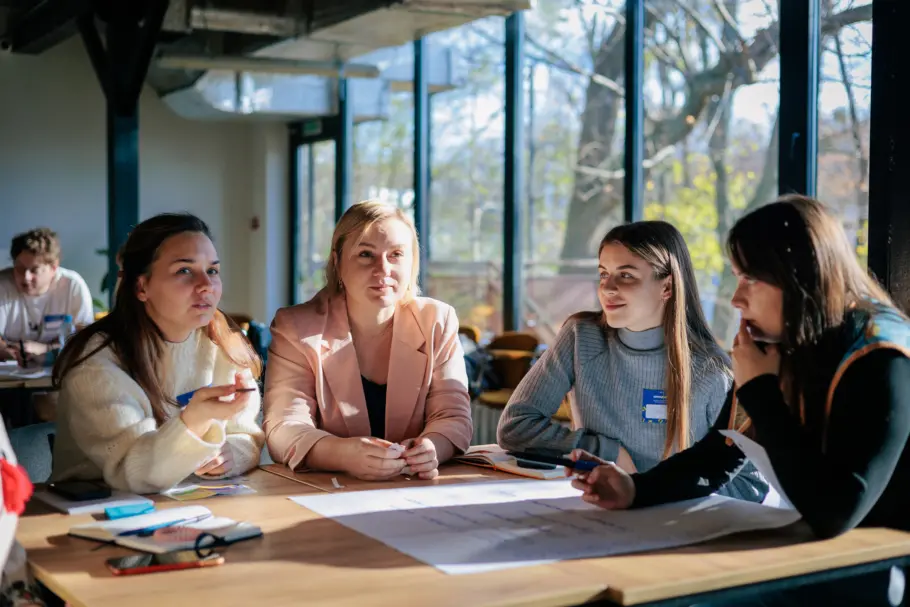
Presentation of the “2025 Index of Sustainability of Civil Society Organizations in Ukraine,” organized by the Ukrainian Independent Center for Political Research. Screenshot from the video
According to Yulia Panura, an expert at the Ukrainian Independent Center for Political Research (UICPR), 2025 was a year of trials for civil society, marked by the consequences of a full-scale war and the transformation of international support following the suspension of USAID programs. At the same time, this period demonstrated the sector’s ability to rally, develop social services, and work on European integration reforms. Panura identified European integration as one of the key drivers of systemic change.
At the same time, she emphasized that support from international partners played a crucial role in enabling Ukrainian organizations to retain their teams and continue their work.
Oleksiy Orlovsky, Director of the “Democracy and Good Governance” Program at the International Renaissance Foundation, stressed that assessing the state of civil society is important not only for the sector itself but also in the context of Ukraine’s movement toward the European Union.
According to him, the EU closely monitors how comfortable civil society feels in a country seeking membership in the European Union. Therefore, the regular publication of the Sustainability Index allows us to see not only individual problems but also the dynamics of change within the sector.
Orlovsky specifically highlighted the study’s methodology. The index largely captures the perceptions and self-assessment of civil society—the extent to which organizations feel capable and how comfortable or uncomfortable they feel during a specific period. That is why, he said, it is important for representatives from different regions of Ukraine to participate in the assessment, as the situation and perceptions of challenges can vary significantly across different parts of the country.
For “Vidrodzhennia,” Orlovsky added, it is fundamentally important that Ukrainian civil society have the opportunity to influence decision-making processes and not be excluded from them. The index, he said, is one of the tools that allows us to observe this process as it unfolds.
The Government and the Public Sector: Cooperation Exists, but It Is Uneven
Natalia Oksha, Deputy Director of the Department of Information and Public Communications and Head of Division at the Secretariat of the Cabinet of Ministers of Ukraine, acknowledged that the interaction between the state and civil society cannot be assessed in black-and-white terms.
According to her, cooperation takes place both within the framework of implementing the National Strategy for Promoting the Development of Civil Society and in other areas of public policy—in particular, the country’s recovery and the development of local communities. However, different tasks have varying levels of priority for both the government and the civil society sector itself.
Oksha specifically highlighted the work on legislative changes. She noted that in 2025, the government and civil society organizations worked on issues related to humanitarian aid, volunteer activities, and civic participation. Among the examples she cited were the work of resilience centers, the Ministry of Social Policy, the Ministry of Youth and Sports, the Ministry of Culture, the Ministry of Justice, and the Ministry of Development. She also noted that the Ministry of Internal Affairs operates a communication platform for engaging with human rights organizations, where issues such as the protection of civic activists are discussed.
At the same time, the government representative reported that preparations for drafting a new strategy to promote the development of civil society have already begun. The Secretariat of the Cabinet of Ministers is analyzing the implementation of the current strategy and conducting interviews with civic associations, charitable organizations, and volunteer groups to identify issues and priorities to be included in the new document.
According to Oksha, a public discussion is planned for September on the draft recommendations, which are intended to serve as a roadmap for state policy on civil society development for the next six years.
She emphasized that without civil society itself, the state will not be able to accomplish its goals, since it is civil society organizations and citizens who best understand the problems they face in practice.
Laws Are Being Passed More Slowly Than Ukraine Is Moving Toward the EU
Olga Lymer, Executive Director of the RPR Coalition, called 2025 a challenging year for advocating for reforms.
She considers the suspension of USAID programs to be one of the biggest challenges. According to her, this has significantly impacted the work of analytical and advocacy organizations. The CSOs that were best able to adapt were those with strong institutional capacity and a history of receiving support from international donors.
At the same time, 2025 also demonstrated the strength of civil society. Lymar recalled the protests against a bill that would have limited the powers of NABU and the SAP. In her view, these protests showed that even under martial law, citizens are capable of using democratic mechanisms to exert influence.
But at the same time, she said, another problem emerged—a slowdown in the work of parliament and in European integration processes.
“The European integration process, at a time when we are moving rapidly toward the European Union, has failed. Many European integration laws have not been passed,” said Lymar.
She also drew attention to delays in decisions related to the Ukraine Facility and to the fact that a number of bills were not adopted in the versions that civil society organizations and think tanks had been advocating for years. According to Lymar, Ukraine is already feeling the consequences of this.
She cited changes in the government as a particular challenge. Due to changes in the deputy prime minister, negotiators, and the composition of working groups, civil society has effectively had to rebuild its working relationships with the government from scratch. Some negotiating groups, in which CSO representatives had previously participated, have effectively ceased to function following these changes.
“This creates uncertainty for civil society organizations regarding who we work with and how, how we establish contacts, and whether there is a systematic approach,” Lymar explained.
Another underdeveloped tool is public consultations. According to Lymar, the law is supposed to take effect after martial law ends, but for now, it does not apply to members of parliament, even though this is provided for in the roadmap for the functioning of democratic institutions.
At the same time, she cited the work on the practical application of the public consultation mechanism as a positive outcome. She noted that many members of parliament with whom civil society organizations have worked have responded positively to this tool.
“We don’t have the money” is no longer a sufficient explanation
The issue of financial sustainability was a recurring theme in virtually all of the speakers’ remarks during the presentation.
Mila Leonova, director of the Alliance of Ukrainian Civil Society Organizations, believes that funding cuts have made the market more competitive, but at the same time have forced Ukrainian organizations and donors to seek new models of support.
According to her, many new financial instruments, funds, and regranting programs emerged in 2025. In particular, Norway, Sweden, and Germany launched new programs. Some of these programs are administered by international organizations, but they expand access to resources for Ukrainian CSOs.
In other words, according to Leonova, the issue is not merely that Ukrainian organizations are receiving less direct funding. The very architecture of donor support is changing: more channels and mechanisms for distributing funds are emerging.
At the same time, this model has its weaknesses. Resources are distributed unevenly: large organizations have more opportunities to attract funding, while small CSOs, especially in frontline areas, are forced to constantly fight for visibility and access to resources.
Leonova believes that one solution could be consortia and joint funding mechanisms, where several organizations pool their capabilities and become more transparent partners for donors. In her transcript, she mentions a consortium that has already brought together more than ten Ukrainian organizations.
She identified the localization of humanitarian aid—the transfer of resources and leadership directly to Ukrainian organizations—as another important area.
According to her, Ukrainian CSOs are already demonstrating to international partners their ability to work independently. Professional civil society sectors are taking shape in the country, and the crisis conditions are stimulating the emergence of new models of cooperation.
At the same time, Leonova cautioned against a situation where only the largest or most well-known organizations have access to international opportunities. She called on the sector to step outside its own “bubbles” and strengthen cooperation among humanitarian, human rights, development, and recovery organizations.
Organizations need money not only for projects
Galina Masira, director of the “Philanthropy in Ukraine” organizational capacity-building program, highlighted another issue: donor-funded projects often do not provide organizations with sufficient resources for their institutional operations.
According to her, one of the main demands from international partners, government institutions, and civil society itself today is transparency. But transparency is impossible without financial stability and the ability to invest in organizational development.
Masira stressed the need to allocate funds in projects for so-called overheads—indirect expenses that allow an organization to operate between projects, retain its team, develop internal processes, and ensure sustainability.
“It is precisely this stability that is the key to building sustainability, transparency, and demonstrating the growth of their organizations,” she emphasized.
Another trend is organizations’ attempts to diversify their revenue streams and secure funding from sources other than grants. This includes, in particular, selling services and creating their own products.
But here, according to Masira, a contradiction arises: on the one hand, organizations are advised to become more self-sustaining, while on the other, legislation contains barriers that complicate this model.
Banking regulation has become a barrier in its own right
Among the most practical challenges in the legal environment, the participants in the presentation cited banking services.
An expert from the Ukrainian National Center for Policy Development noted that civil society and charitable organizations face excessive scrutiny from commercial banks regarding founders, ultimate beneficial owners, fund transfers, and account freezes.
The problem lies in the fact that approaches designed for the commercial sector are effectively being applied to CSOs, and banks, in an effort to minimize their own risks, are tightening their checks as much as possible. This particularly complicates the work of organizations conducting humanitarian activities abroad.
Tetyana Pechonchyk, director of the ZMINA Human Rights Center, separately confirmed this issue. She emphasized that a practical challenge for civil society organizations is the ability to make payments to the accounts of foreign counterparties.
According to her, due to regulatory restrictions, Ukrainian organizations cannot always serve as leaders of international projects and are forced to remain their subcontractors. Pechonchik believes that this regulation needs to be revised, as it directly limits the ability of Ukrainian civil society to operate at the international level.
A separate section of Tetiana Pechonchik’s remarks focused on the safety of civil society activists.
In 2025, the organization documented 178 cases of persecution of civil society activists in territory controlled by the Ukrainian government. More than 60% of these cases were linked to Russian aggression. These included missile and drone attacks, the deaths of volunteers in frontline areas, and the deaths of activists as a result of indiscriminate strikes. According to Pechonchik, 26 deaths of civic activists and volunteers linked to Russian aggression were recorded in 2025.
However, the director of ZMINA emphasized that it is particularly important to examine cases that were not directly caused by Russian aggression.
She noted that there were 66 such cases. While physical attacks on activists decreased compared to the period before 2022, the number of legal forms of persecution—particularly SLAPP lawsuits and criminal proceedings—has increased.
Pechonchik cited several examples. Among them is the criminal prosecution of Vitaliy Shabunin, head of the Anti-Corruption Action Center, which more than 100 civil society organizations, including ZMINA, consider to be politically motivated.
She also mentioned the criminal case against Lviv activist Maksym Shumakov, the persecution of environmental activists, and the case of two minors who participated in a protest against the felling of oak trees; the police took them to the police station and, according to Pechonchik, threatened them with further pressure if they continued to protest.
Thus, in her assessment, even with the existence of communication platforms between the government and the human rights sector, the issue of activists’ safety remains unresolved.
Another critical challenge is the gap between the existence of government plans and their implementation.
Participants in the presentation noted that in 2025, the government adopted an action plan for the development of civil society for 2025–2026. At the same time, some commitments related to European integration and legislative changes remained unfulfilled.
Maksym Latsyba, an expert at the Ukrainian National Center for Policy Development (UNCPD), specifically highlighted the failure to implement plans regarding civil society legislation and problems with advancing government bills in parliament.
He cited as an example the bill on civic organizations, which, he said, has been included in plans for many years in a row, but its adoption is constantly being postponed.
Criticism was also voiced regarding the implementation of changes in the field of humanitarian aid. According to the speaker, legislative changes have already been adopted; however, for them to be fully effective, a corresponding government resolution and the creation of a registry of verified civil society and charitable organizations are necessary. This pertains, in particular, to the ability to import humanitarian vehicles for statutory activities, the deployment of humanitarian workers, and travel abroad for humanitarian missions.
In Latsyba’s view, the state must move more quickly from the adoption of documents to their practical implementation.
Human capital is becoming one of the main risks
The challenges faced by people working in the public sector were raised in most of the presentations.
Participants emphasized that organizations are operating under conditions of war, constant pressure, unstable funding, and competition for resources. In the social sector, workers are often effectively working beyond their capacity.
Oleksandr Solontay, Chairman of the Board of the Agency for Recovery and Development, drew particular attention to the issue of human capital.
According to him, civil society in Ukraine has “survived” despite the blows it has suffered, but the risks have not gone away. Among them, he cited the state of human capital under martial law and the inability of the government to adapt quickly enough to the needs of society.
Solontay believes that the state should view civil society not as an additional critic or competitor, but as an ally in ensuring Ukraine’s resilience.
According to Solontay, another challenge has been the constant turnover of government officials. Every time a minister or deputy minister is replaced, civil society organizations must once again explain the basics, reestablish contacts, and convince the new official of the importance of previously agreed-upon decisions.
“The constant need to re-advocate to whichever minister or deputy minister has just been replaced,” he says.
Civil society itself is seeking new models of sustainability
Despite the challenges, the presentation participants spoke not only about the crisis but also about the changes that resulted from it.
Mila Leonova pointed out that the reduction in international funding has spurred new models of cooperation, regranting, and localization. New funds and programs are emerging in Ukraine, and Ukrainian organizations themselves are becoming increasingly active in shaping international rules regarding humanitarian aid.
According to her, Ukraine is already participating in international processes that define the rules of localization, the quality of partnerships, and the accountability of international aid. At the same time, she emphasized that not all organizations have access to these opportunities yet.
Therefore, one of the sector’s main internal tasks should be to overcome its own fragmentation and create mechanisms that will allow smaller organizations to gain access to resources through collaboration and consortia.
Olga Lymer specifically noted that Ukrainian civil society can no longer be viewed as a single monolith.
According to her, reform-oriented organizations, think tanks, watchdog organizations, and anti-corruption bodies may hold differing positions on specific issues. And this is not necessarily a negative thing.
“There is no clear consolidation within civil society,” said Lymar, adding that different positions have a right to exist.
At the same time, other participants in the presentation emphasized that cooperation among different parts of the sector could be the answer to the reduction in resources.
Participants in the presentation agree: Ukrainian civil society not only survived 2025 but also changed as a result of the crises. On the one hand, the sector has become more professional, has begun to collaborate more actively, seek alternative sources of funding, form consortia, develop its own services, and influence international humanitarian aid regulations. On the other hand, organizations are operating in a significantly more complex environment. Cuts to donor programs, unequal access to resources, instability in government policy, banking regulation issues, unfinished legislative changes, risks to activists, and team burnout simultaneously create multiple layers of threats to the sector’s sustainability.
The civil society sector needs not only grants but also the ability to plan its activities several years in advance. Not just declarations of support for volunteerism, but resources for its development. Not just legislative plans, but laws that have been passed and implemented. Not just communication channels with the government, but real influence over decisions. Not just transparency requirements, but funding for institutional development. And ultimately, not just recognition of civil society’s role, but an understanding of it as one of the key elements of a nation’s resilience.
As a reminder, in 2022, the sustainability index for civil society organizations in Ukraine stood at 3.1 on a scale of 1 to 7, where 1 is the highest score.
Source: ZMINA