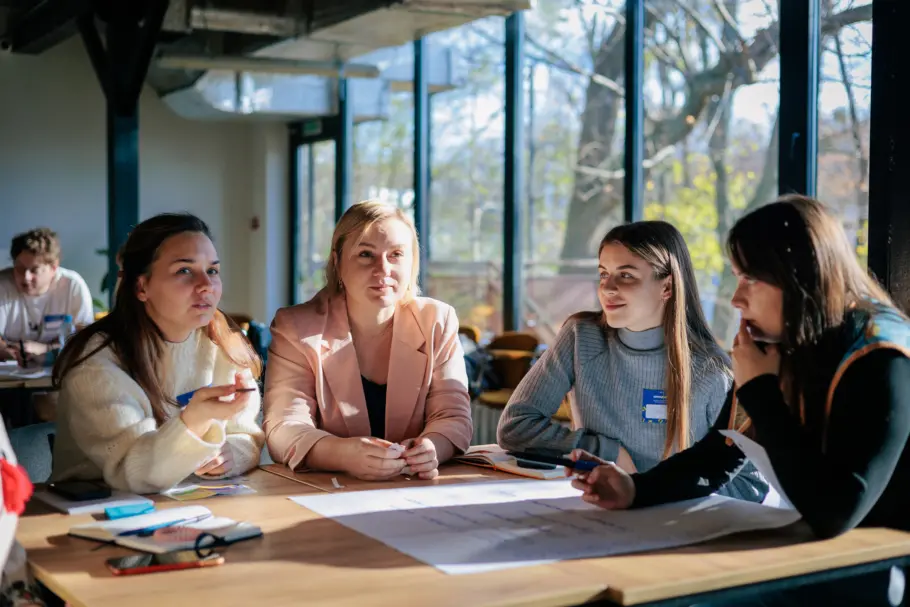
More than 250 attendees, 30 speakers, and 15 events: The pilot “Ganok” Democracy Festival took place in Poltava
On August 8, Ukraine’s first “Ganok” Democracy Festival took place on the lawn of the Vasyl Krychevsky Poltava Local History Museum. This year, the event was held outdoors as a pilot project based on a Scandinavian model established in the mid-20th century
The organizers have already announced the second “Ganok” for 2027.
On Saturday, August 8, Poltava hosted the “Ganok” Democracy Festival for the first time—a free, open-air event open to everyone. “Ganok” drew about 250 visitors from Poltava and the Poltava region, Kyiv, Lviv, Kharkiv, the Donetsk region, Dnipro, and cities and towns in other Ukrainian regions, as well as international guests from the Netherlands, the United States, Taiwan, the Czech Republic, France, the United Kingdom, and Poland. The festival was co-organized by the INDEX Cultural and Research Center and the “Tereny” Cultural Agency, with support from the International Renaissance Foundation and the Robert Bosch Stiftung. INDEX documents Russia’s war against Ukraine through fellowships and international intellectual exchange, while “Tereny” develops, preserves, and promotes the culture of Ukrainian regions—particularly the Poltava region—through events and programs.
Over the course of a single day, approximately 30 speakers took the stage at the festival, reflecting on various topics and engaging with visitors across 15 events. This year’s program focused on discussions about decolonization, local civic and cultural initiatives from various Ukrainian cities, art by veterans, national communities and indigenous peoples of Ukraine, and the direct role of democracy in protecting against authoritarian regimes.Over the course of a single day at the festival, approximately 30 speakers participated in 15 events, reflecting on various topics and engaging with attendees in different formats. This year’s program focused on discussions about decolonization, local civic and cultural initiatives from various Ukrainian cities, art by veterans, national communities and indigenous peoples of Ukraine, the direct role of democracy in protecting against authoritarian regimes, and more.
In addition to the on-stage talks, visitors could explore a craft fair featuring local artisans, try out a drone flight simulator from “Charter-Hub,” and chat with the Veterans Center; they could also listen to the voices and songs of Ukraine’s indigenous peoples at an installation by Post Bellum -Ukraine, participate in storytelling and visual thinking workshops where they learned to tell and illustrate stories, take a guided tour of Poltava, and listen to the music and poetry of Oleg Kadanov.
“As the program’s curator, it was important for me to address the real challenges facing contemporary democracy, which arise against the backdrop of rising authoritarianism, growing populism, and shifts in the global balance of power. That’s why we had conversations about decolonization, national communities, and European integration; the restoration of proper names; the importance of culture as a driving force; and coming to terms with the realities of war. I am sincerely grateful to our partners—Ukrainian PEN, the Coalition of Cultural Activists, Razom for Ukraine, the Veterans’ Theater, and Post Bellum—Ukraine—who helped create this program and made it so diverse,” adds program curator Olesia Yaremchuk.
During the welcoming remarks by Hryhorii Baran—director of the “Social Capital” program at the International Renaissance Foundation—the organizers announced that the festival will continue in 2027, which they also plan to hold in Poltava.
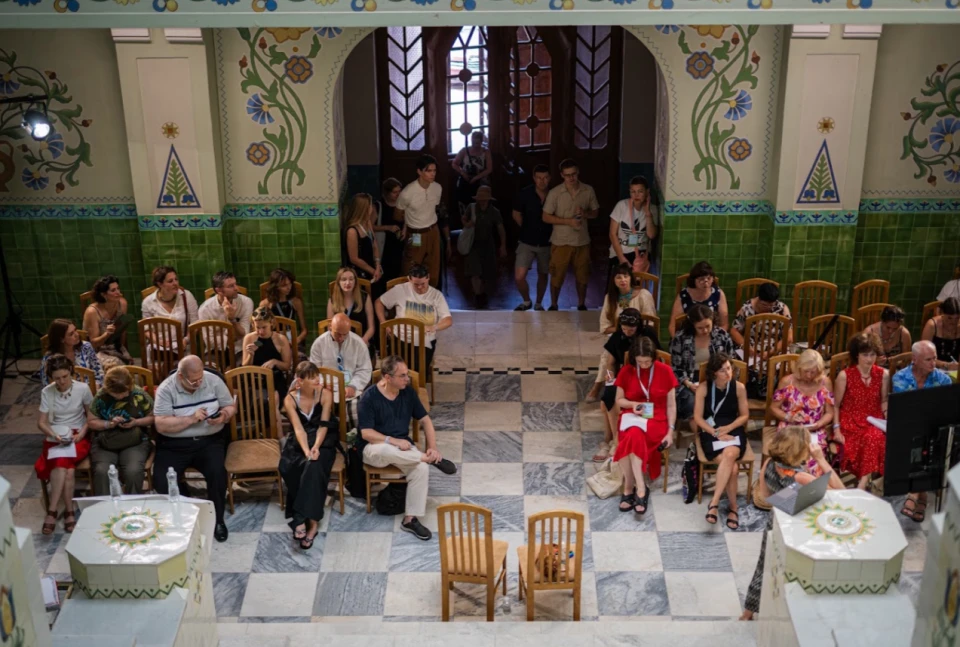
Photo: Stanislav Pantelei
“Democratic practices are not limited to the electoral process. The pilot festival of democracy in Ukraine has shown that, under martial law, we desperately need this tool—a platform for dialogue that allows people from different regions, social groups, and cultural backgrounds to find common ground and shape a vision for the future. It is crucial that guests from abroad joined us and got to know Ukraine beyond the capital. ‘Ganok’ is set to become an annual event and put Ukraine on the map of the European Association of Democracy Festivals,” said Sasha Dovzhik, head of the INDEX Cultural Research Center, summarizing the festival’s results.
The festival’s main goal is to decentralize major cultural events and public dialogue with society, which in Ukraine predominantly take place in hubs like Kyiv and Lviv. Geographical proximity to the contact line is also important to the organizers. According to them, such events should be held as close as possible to where democracy is being defended in real time, while taking security factors into account.
“Our agency’s main motto is ‘Grow from the Roots.’ We are convinced that Ukraine’s development is impossible without the decentralization of cultural processes—as we discover, preserve, and strengthen the local heritage and unique identities of our regions. For “Tereny,” the Poltava region became our first priority, and holding the festival here is a logical and important part of our mission. “The first festival brought together the Poltava community, artists, military personnel, and experts around shared values and provided an opportunity for open dialogue, which is especially important during wartime,” says Tetiana Teren, head of the “Tereny” cultural agency, commenting on the importance of the local context.
Democracy festivals, as a format for public events, originated in Sweden in 1968 in the city of Visby, where then-Minister of Education Olof Palme delivered a political speech from the back of a truck. Today, they attract tens of thousands of visitors annually and serve as a space for uncensored and unrestricted dialogue between citizens, authorities, and the active public. Festivals from various countries are united in an association that includes Northern Ireland, Norway, Sweden, Finland, Denmark, Estonia, Latvia, and Iceland. Following its launch in Poltava in 2026, the Ukrainian festival “Ganok” also plans to become a member of the Association.
Source: Espreso